Alibaba Cloud Malaysia staged the first Qwen conference in Kuala Lumpur on 19 November 2026, and used it for three announcements: a third data centre in Johor, the Qwen4-Max flagship model, and another 100,000 places in a national AI training programme.
The conference ran a full day with QwenWork as platinum sponsor, Cloud Vision and VST ECS as gold sponsors, MDEC as strategic partner, and a partner wall that reads like a map of the local channel. The argument that held the day together was narrower than the product list: Malaysia has adopted generative AI faster than most markets in the region, and has converted very little of it into measurable operating value.
Last updated: 19 November 2026. This report is built from the on-stage sessions recorded at the conference, the event’s own programme, and the official Alibaba Cloud releases cited at the end. Figures spoken from the stage are attributed as stage statements, not as independently audited results.
Alibaba Cloud Malaysia: the short version for business
- Alibaba Cloud said its third data centre in Johor is already running, taking its Malaysian footprint to two cloud regions and six availability zones.
- Qwen4-Max, announced globally on 16 November 2026, was presented as a model built for agents rather than chat: 2.4 trillion parameters, 71 billion active per token, a one-million-token context window, and native text, image and video input.
- Three products sat under it: Qoder for coding, QwenWork for general enterprise work, and WonderClip for video.
- With the Ministry of Digital, Alibaba Cloud opened Kita Bersama AI, aimed at 100,000 Malaysians aged 18 to 30 and running for two months to January 2027.
- Malaysian builders on the panel argued that the gap is not model quality but local context, and the local cloud capacity to serve it.
What happened in Kuala Lumpur
The opening keynote framed the agenda around one line that stayed on screen for most of the morning: bridging the gap between tokens and business value. The two-part answer offered from the stage was an intelligence factory that turns compute and data into tokens, and an agentic cloud where those tokens do work, with the tools, memory, context and governance an agent needs to act rather than answer.
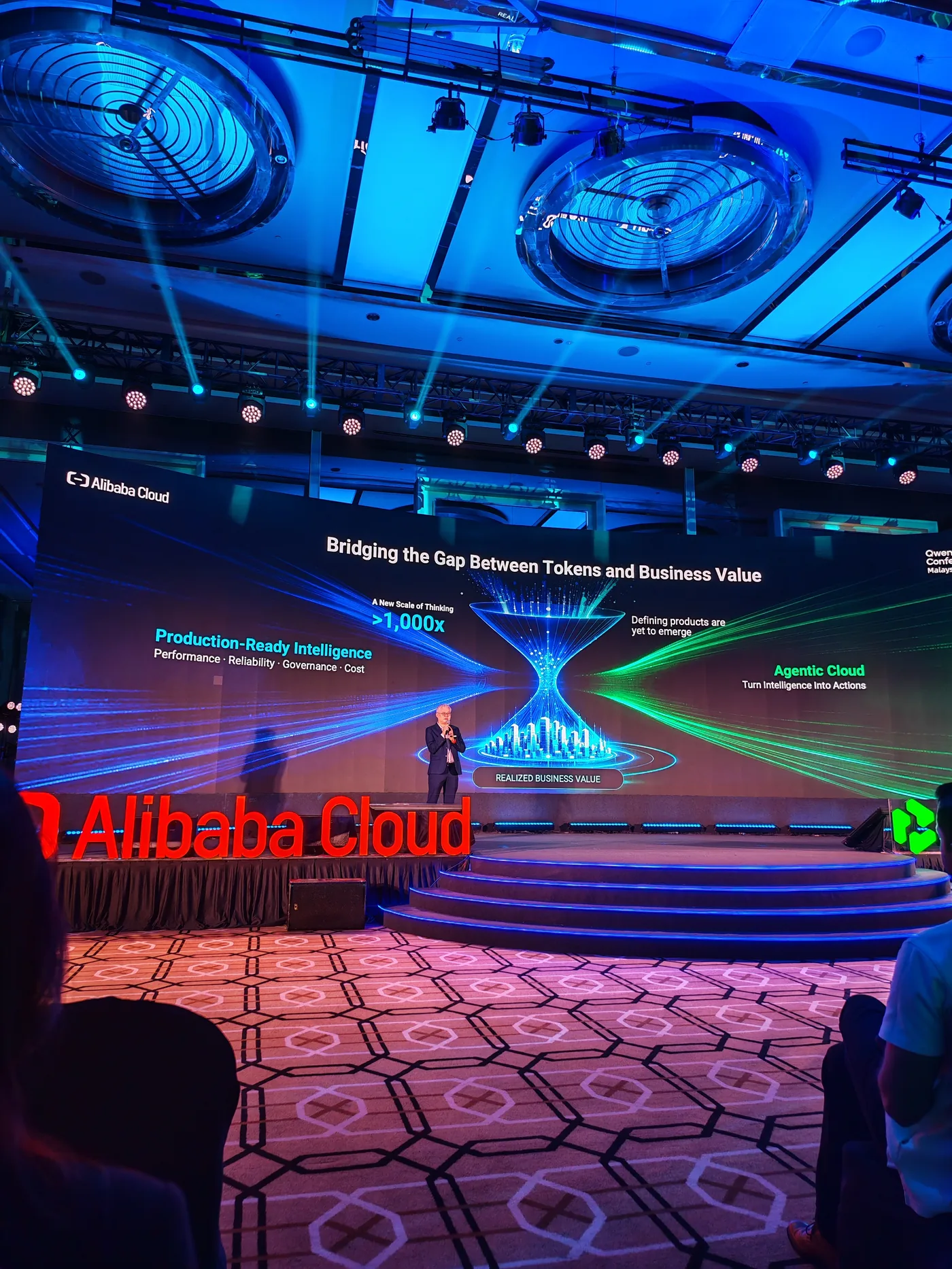
Photo: BD Media, 19 November 2026. The opening keynote’s framing slide at Qwen Conference Malaysia 2026, Kuala Lumpur, setting out a token layer and an agent layer as two halves of one stack.
Tokens, in that framing, are the new electricity. The first thing electricity needs is a grid close enough to the customer, which is where the Johor announcement belongs.
A third Johor data centre, and what availability zones actually buy
Alibaba Cloud said the third Johor data centre is already launched, bringing its Malaysian total to two cloud regions and six availability zones. Regionally the company now counts 32 regions and 109 availability zones, and the Johor build sits inside a global AI infrastructure commitment the group has previously put at about RM216 billion, converted at RM4.07 to the US dollar.
The arithmetic that matters to a Malaysian buyer is not the region count. Availability zones are failure domains. Three zones in one region let a database run synchronous replication and survive the loss of a single facility; two regions inside the same country let disaster recovery sit in Malaysia instead of Singapore. Both were expensive or impossible to arrange locally two years ago.
The keynote’s own framing was more candid than most vendor keynotes: the added capacity exists to close the gap between AI demand and infrastructure supply in this market, not to serve a global queue.
The adoption numbers the keynote put on the wall
Before any product slide, the keynote put Malaysia’s own numbers up and left them there. Nineteen per cent of Malaysian workers use generative AI daily, 46 per cent of firms describe themselves as AI first movers, and 90 per cent of organisations say they plan to deploy agents within twelve months. Approved ICT investment for 2025 was put at RM152.9 billion, sourced on the slide to MIDA in April 2026 and attributed largely to AI data centre and cloud demand.
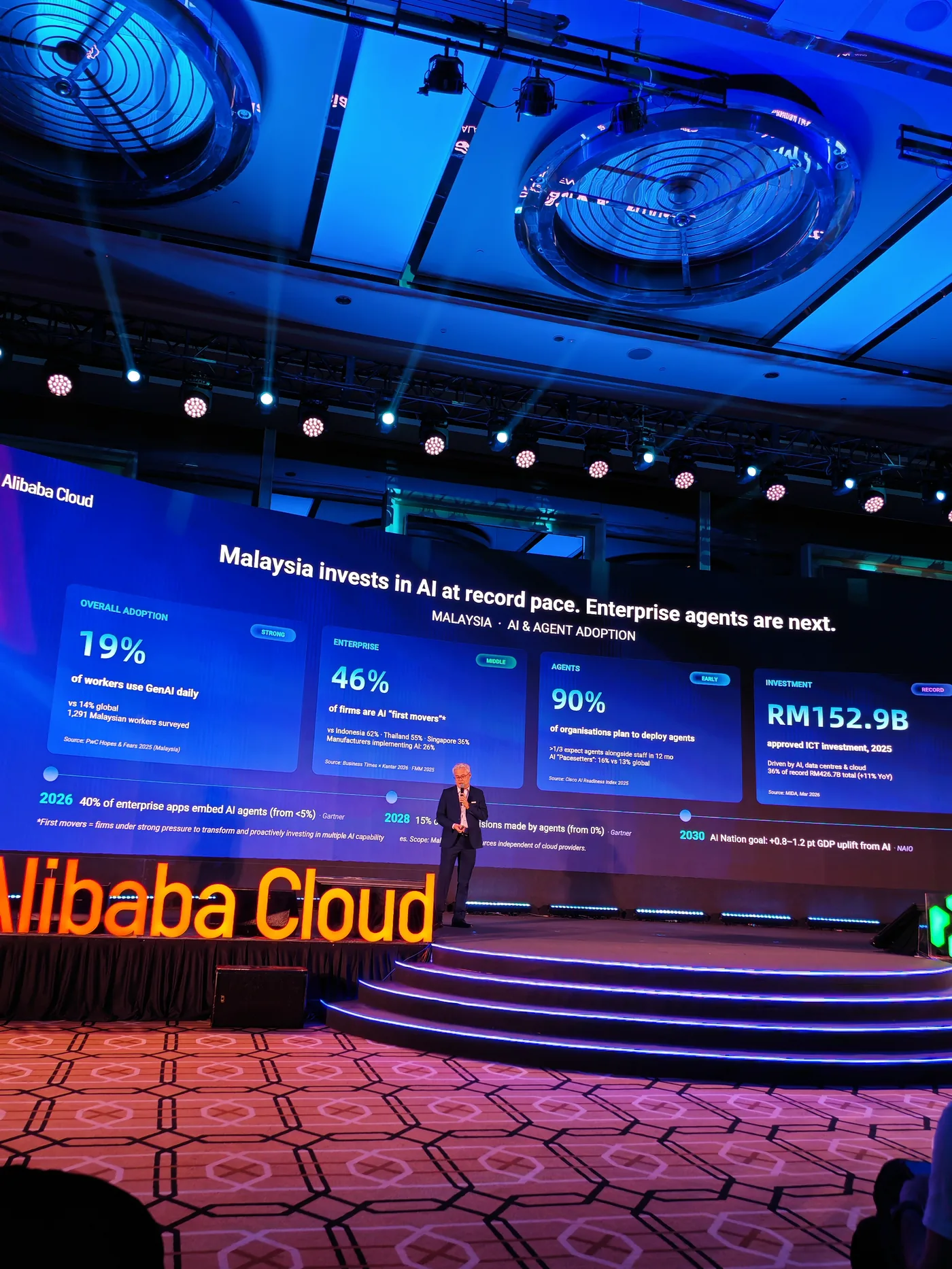
Photo: BD Media, 19 November 2026. The Malaysia adoption slide from the opening keynote, carrying the 19 per cent, 46 per cent, 90 per cent and RM152.9 billion figures used in this section.
Read together, those four numbers describe a market that has finished experimenting and has not finished implementing. That gap is the commercial opportunity the rest of the day was built to address, and it is also the honest description of where most Malaysian SMEs sit: tooling in place, process unchanged.
Qwen4-Max: what changed, and what it costs to run
Qwen4-Max was launched globally on 16 November 2026, three days before the conference, and it carried the technical sessions. The architecture is a redesigned sparse mixture-of-experts, applied across attention, residuals and embeddings rather than only the feed-forward blocks that most sparse models modify.
| Attribute | Qwen4-Max, as announced |
|---|---|
| Total parameters | 2.4 trillion |
| Activated per token | 71 billion |
| Context window | 1 million tokens |
| Inputs | Native text, image and video |
| Input price, cache hit | About RM0.31 per million tokens, converted at RM4.07 to the US dollar from the vendor’s published rate |
| Claimed efficiency | Roughly 35 per cent fewer tokens than the previous flagship at high reasoning effort, about 60 per cent lower cost per task |
| Cited benchmark standing | 6th on Code Arena at launch; ahead of the previous flagship on the vendor’s own 721-field Work360 suite |
Source: Alibaba Cloud press release and Token Plan product notes, 16 November 2026. Efficiency and benchmark figures are vendor-reported and not independently reproduced.
Two claims sit above the parameter count. The first is token efficiency: fewer tokens per completed task at high effort. The second is that the model is built for agents, with tool calling, structured output and API compatibility treated as core rather than added later.
Efficiency is the claim a Malaysian business should test, because in agentic work the invoice is driven by how many tokens a task consumes and how often it has to be retried, not by the price of a million tokens on a rate card. A model that finishes in fewer turns at a slightly higher list price is frequently the cheaper one, and no vendor rate card shows that.
Qoder, QwenWork and WonderClip: the layer above the model
Three products sat under the model, and the framing was about production rather than demonstration. Qoder is the coding agent, with a stated 30 million users in its first month and half of them inside enterprises. QwenWork is the general productivity platform, with a model selector so a team can trade quality against cost per task. WonderClip is the video engine, and it has a Malaysian thread: it appears on the tool list offered through the AI Untuk Rakyat programme, alongside YTL AI Labs’ IlmuChat, MuleRun and Google’s Gemini Enterprise.
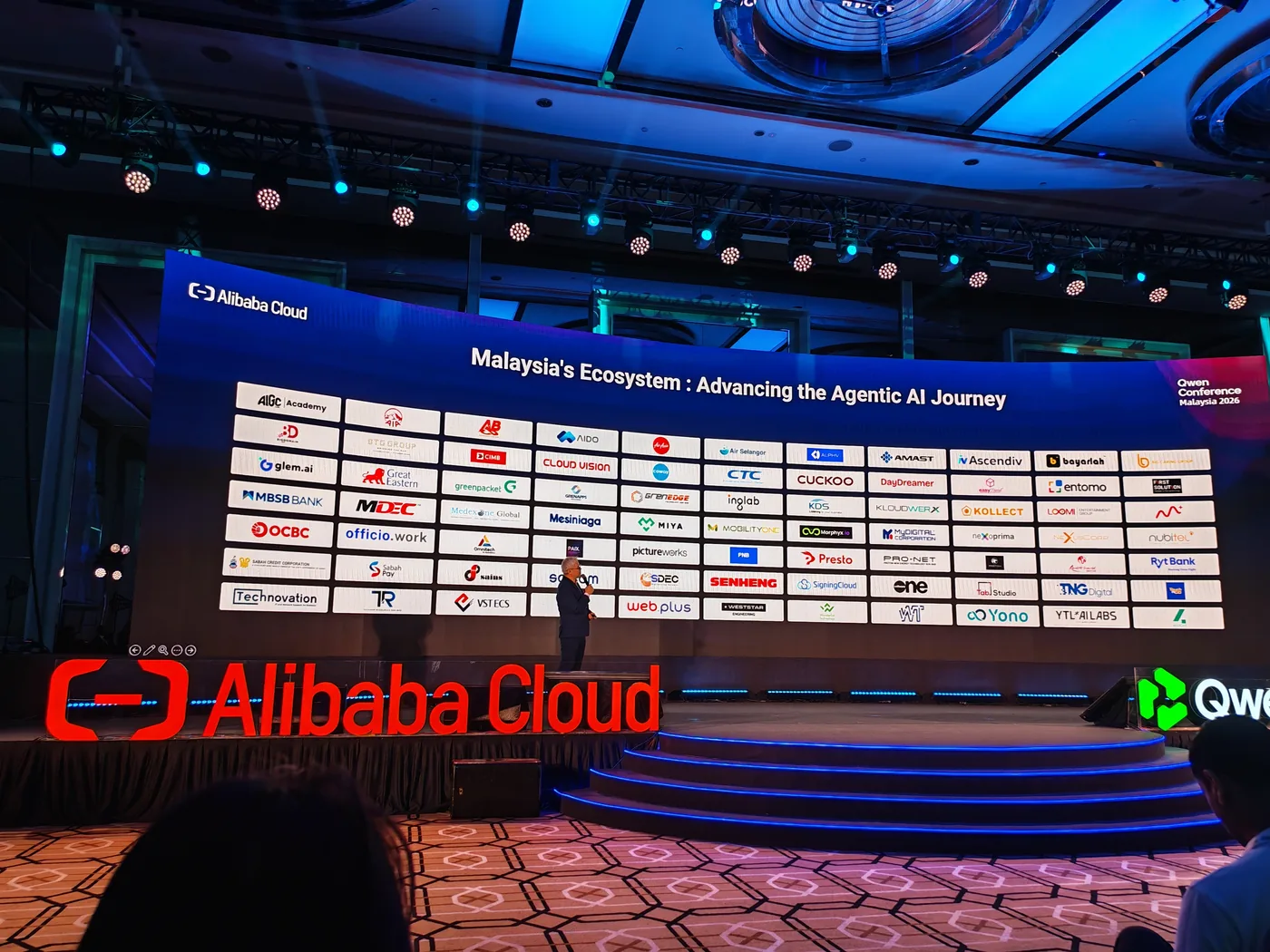
Photo: BD Media, 19 November 2026. The partner wall shown during the afternoon sessions, which places MDEC, MIMOS, TNG Digital, Ryt Bank and YTL AI Labs inside the same agentic-AI programme.
The keynote was explicit that these products get their real detail in the breakout rooms rather than the main stage. Most of the day’s practical content sat there.
Kita Bersama AI: another 100,000 Malaysians, by January 2027
The announcement with the widest reach had nothing to do with models. Alibaba Cloud, with the Ministry of Digital, opened Kita Bersama AI from the stage: a nationwide programme for 100,000 Malaysians aged 18 to 30, running two months to January 2027 across three tracks covering learning, working and creating.
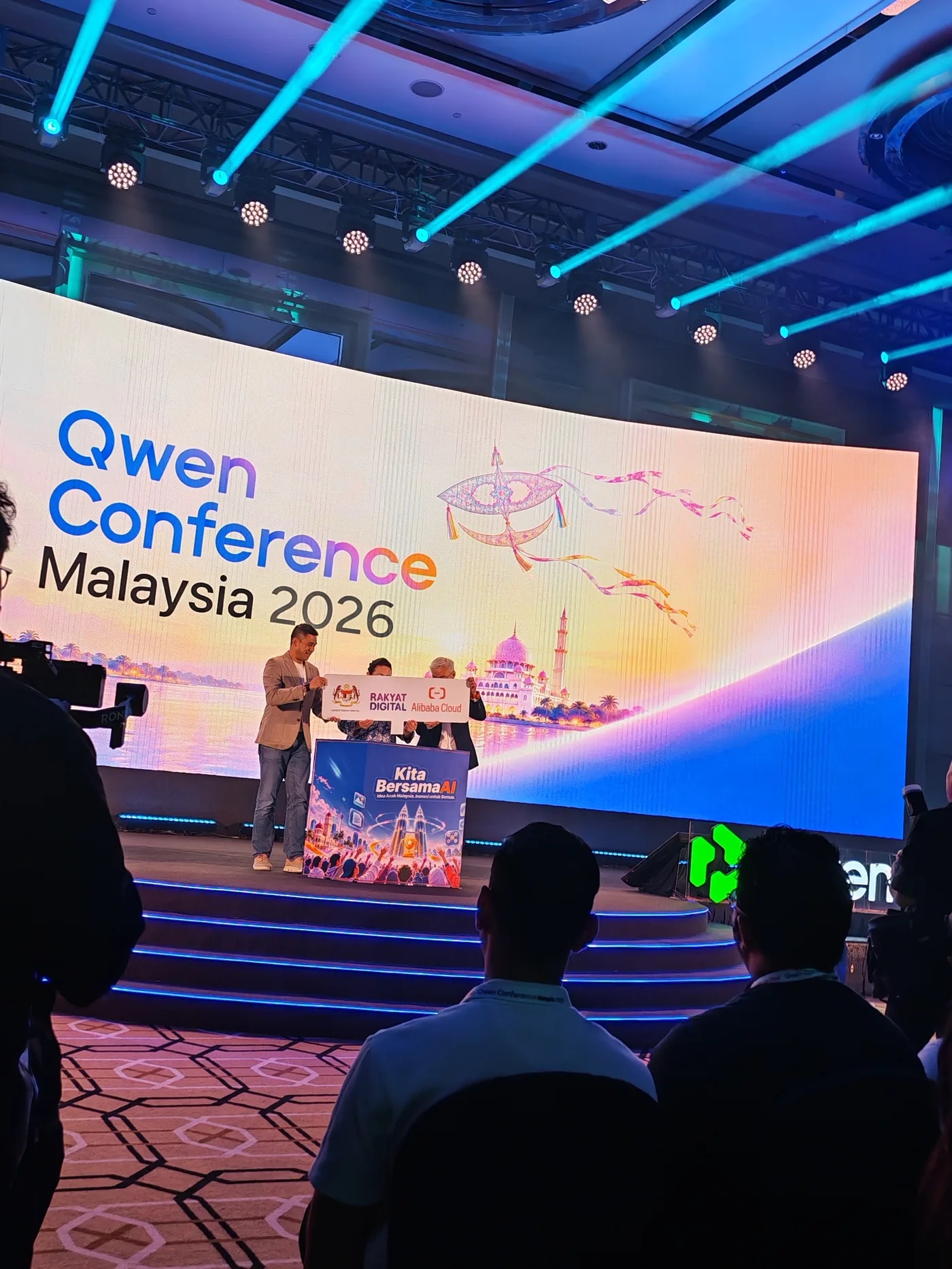
Photo: BD Media, 19 November 2026. The Kita Bersama AI launch on the main stage, with the Rakyat Digital and Alibaba Cloud marks on the podium and the conference backdrop behind.
It extends AI Untuk Rakyat, the national AI literacy programme started in January 2024 and expanded in August 2026 with a youth track. Under the current phase, Malaysians aged 18 to 30 who complete six modules on the Rakyat Digital portal, covering AI Nation 2030, CYBERSAFE, Generative AI, AI Security, Agentic AI for All and Cloud for the People, receive three months of free access to selected AI tools.
The policy track is moving at the same pace. The Ministry of Digital has said the AI Governance Bill is targeted for tabling in Parliament early next year, with the Malaysia AI Safety Institute working on safety benchmarking and risk assessment, and MY-AI Standards being developed with SIRIM. MDEC has committed to helping 4,000 micro, small and medium enterprises adopt AI, and to training and certifying 5,000 AI professionals.
Read as a pair, free tooling for the young and a governance bill for everyone describe the market Malaysian SMEs will be selling into over the next two years.
Local context beats raw intelligence
The most useful session of the day was not about benchmarks. One Malaysian builder opened with a test: ask a general-purpose model, by voice, for the nearest McDonald’s in Bukit Mertajam. The model heard Bukit Panjang, a town in Singapore, and sent the user to another country.
The point lands harder here than almost anywhere else in the region. Three languages in daily use, place names that collide with a neighbour’s, and customers who switch between English, Bahasa Malaysia, Mandarin and Tamil inside one sentence. A model that scores 95 per cent on an English benchmark can still be useless at a counter in Seberang Perai.
The same session pointed at Ryt Bank, described on stage as Malaysia’s first AI-native digital bank, where the customer journey is being rebuilt around conversation rather than forms. Elsewhere in the programme the infrastructure conversation turned to bare-metal supernodes and high-bandwidth memory, with Malaysian partners saying they are still exploring multi-model bare-metal deployments. That is an honest signal about where the local ecosystem sits: early, not finished.
What this changes for a Malaysian SME
Strip out the vendor framing and five things are actionable this quarter.
Measure cost per task, not cost per token. Model choice should be judged against completed work: how many tokens and how many attempts a real task consumes. Running the same three tasks through two models for an afternoon settles it, and the number that matters is review time, not the rate card.
Local capacity changes the architecture options. Two regions and six availability zones inside Malaysia make in-country disaster recovery and multi-zone databases a design decision rather than a budget problem, which matters most for businesses whose customers will not accept a Singapore failover.
Governance before scale. Every serious deployment described on that stage carried a control layer: what the agent may touch, what it must ask about, what gets logged. Retrofitting that layer is what stalls pilots in month four.
The free training tier is government-backed. A business with staff aged 18 to 30 can route them through AI Untuk Rakyat and Kita Bersama AI, which carries structured modules and three months of tooling at no cost to the employer.
A smaller model is a legitimate answer. With a 2.4-trillion-parameter flagship at one end of the range, the engineering decision for most SMEs is which smaller model is good enough for the bulk of the traffic, and which tasks justify the flagship.
Bottom line
The first Qwen conference in Malaysia was not really about Qwen. It was about the distance between a token and a profit-and-loss line, and Alibaba Cloud spent a full day arguing that infrastructure, tooling, governance and local context close it, in that order.
The concrete deliverables from the day are a third Johor data centre already running, a flagship model three days old and built for agents, three products with real enterprise numbers attached, and 100,000 more trained Malaysians promised by January 2027. Models will keep changing every few months. The grid, the tooling and the trained people are the parts that compound.
Sources
- Alibaba Cloud, Alibaba unveils Qwen4-Max, press release, 16 November 2026 (architecture, 2.4 trillion total and 71 billion active parameters, one-million-token context, efficiency claims, Code Arena standing) — alibabacloud.com
- Alibaba Cloud Model Studio, Token Plan product updates, accessed 19 November 2026 (published input pricing for Qwen4-Max) — alibabacloud.com
- Caixin, Alibaba Cloud Hong Kong summit: nine data centres in twelve months, 17 November 2026 (global expansion plan including Malaysia, capacity target to 2032) — companies.caixin.com
- Cloud Reseller News, Future plans revealed at Alibaba Cloud’s Apsara Conference 2026, 2026 (region and availability-zone baseline behind the 32 regions / 109 zones figure) — cloudresellernews.com
- Rise Malaysia, AI Untuk Rakyat guide, accessed 19 November 2026 (youth track, six modules, three months of tool access, WonderClip on the tool list) — risemalaysia.com.my
- The Star, AI safety enforcement framework prepped ahead of new bill, 17 November 2026 (AI Governance Bill timing, MDEC 4,000-SME and 5,000-professional commitments) — thestar.com.my
- Qwen Conference Malaysia 2026, event listing (date, venue city, organiser, sponsor tiers) — rifio.dev
BD Media is the editorial desk of Big Domain. This report records what was announced and said from the stage at Qwen Conference Malaysia 2026, together with the vendor releases behind each figure. Stage statements on data-centre counts, model efficiency and programme targets are reported as statements, not as audited results. Photographs were taken at the event by BD Media.