
On 17 September 2026 the government raised the monthly electricity consumption threshold that separates a protected household from an exposed one. It moved from 600 kilowatt-hours to 800.
Prime Minister Anwar Ibrahim announced it the same day, after a special meeting at the Ministry of Finance that ran about an hour. Deputy Prime Minister Fadillah Yusof, who holds the energy transition and water transformation portfolio, and Second Finance Minister Amir Hamzah Azizan were in the room.
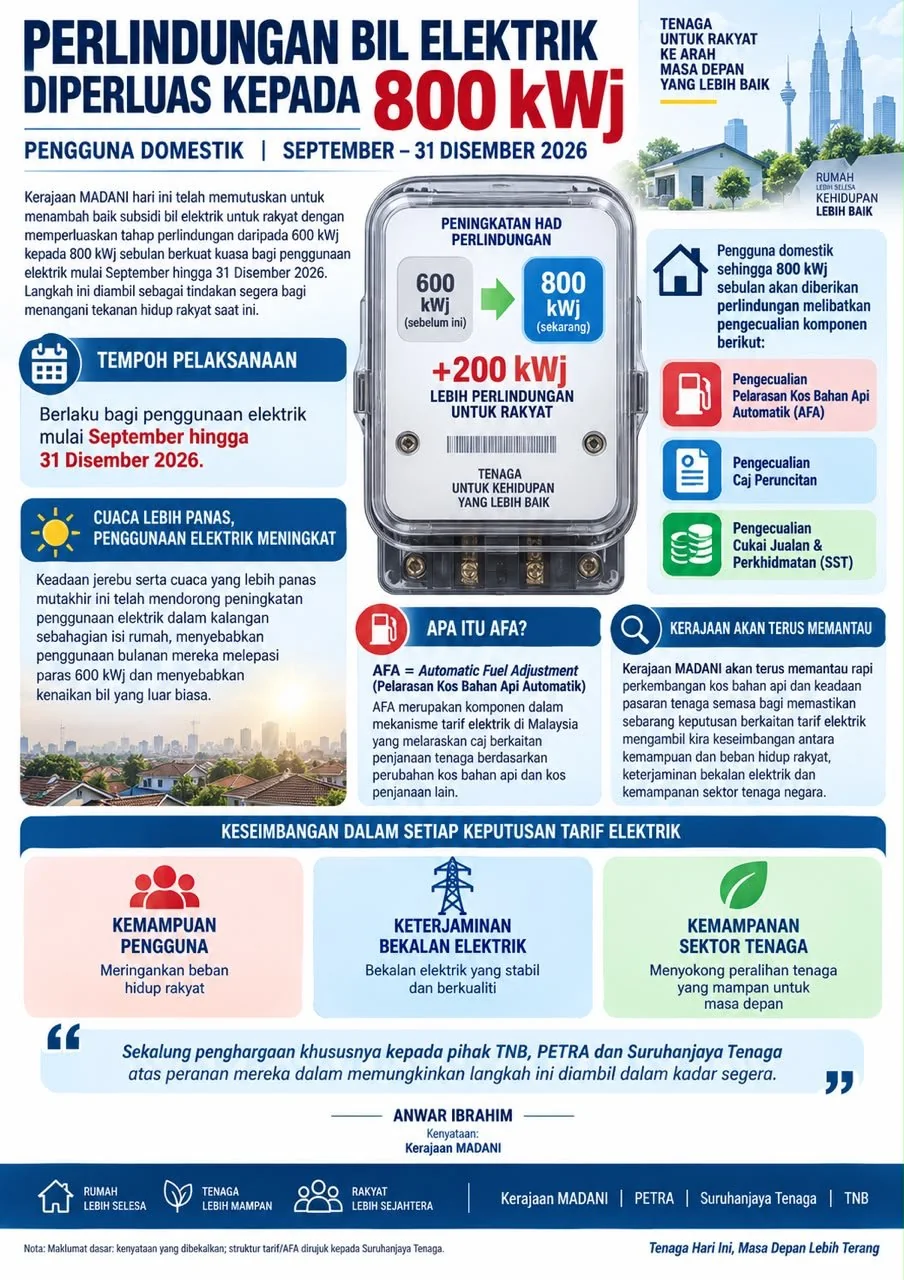
What changed is narrow. A domestic account using 800 kWh a month or less stops paying three separate things:
- the Automatic Fuel Adjustment (AFA), whether that month’s rate is running as a rebate or as a surcharge
- the retail charge, which is RM10 a month on a domestic account
- the 8% service tax
It covers consumption from September 2026 through 31 December 2026. Above 800 kWh nothing changes. A household at 810 kWh keeps paying all three, exactly as it would have at 610 kWh the week before the announcement.
Why the threshold moved now
The stated reason is weather. Haze and hotter days pushed household consumption up, and homes that normally sat well under the 600 kWh line crossed it. “The haze and hotter weather in recent times had driven up electricity consumption among some households, pushing their monthly usage above 600 kWh and resulting in unusually high bills,” Anwar said.
The timing is not a coincidence. The AFA stopped being a discount four months ago.
TNB’s own account of the mechanism runs like this. AFA began on 1 July 2025, replacing the old Imbalance Cost Pass-Through. It is a two-way mechanism: when global fuel costs fall the rate comes back to the customer as a rebate, and when they rise it returns as a surcharge. Households received rebates for nine consecutive months, from August 2025 to April 2026. The surcharge started in May 2026, after generation costs rose on the back of the crisis in West Asia. Since the mechanism began, customers have received RM3.1 billion in AFA rebates against RM0.8 billion in surcharges, and the government has channelled a further RM435 million through the Electricity Industry Fund to cushion the surcharge.
For September 2026 the AFA rate is +3.67 sen per kilowatt-hour, confirmed by the Energy Commission and published on TNB’s tariff page each month.
What the exemption is worth at 800 kWh
The exemption removes three lines from a bill. Their value is not equal.
| Charge | Rate | Effect at 800 kWh |
|---|---|---|
| AFA | +3.67 sen/kWh for September 2026 | The whole AFA line disappears. At September’s rate that line is roughly RM29 on 800 kWh. |
| Retail charge | RM10.00 a month | RM10.00 a month. |
| Service tax | 8% | The taxable amount no longer carries the 8% tax. |
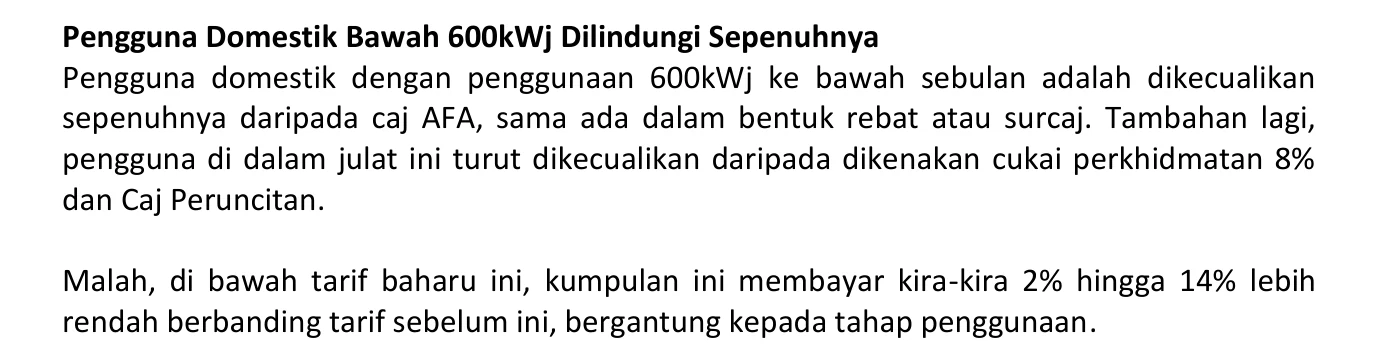
The retail charge is the small one and the easiest to check, because TNB prints it as its own line and the exemption for it was already written into the published tariff schedule. The AFA is the volatile one. It is set monthly, so its value to you changes with the fuel market rather than with your usage.
If you run a business, this announcement is not about you
Read the first line of the graphic again. The measure is written for domestic accounts. A shop, an office, a factory or a workshop sits on a non-domestic tariff, and none of these three exemptions exists at any consumption level. There is no threshold to cross in your favour and no application to file.
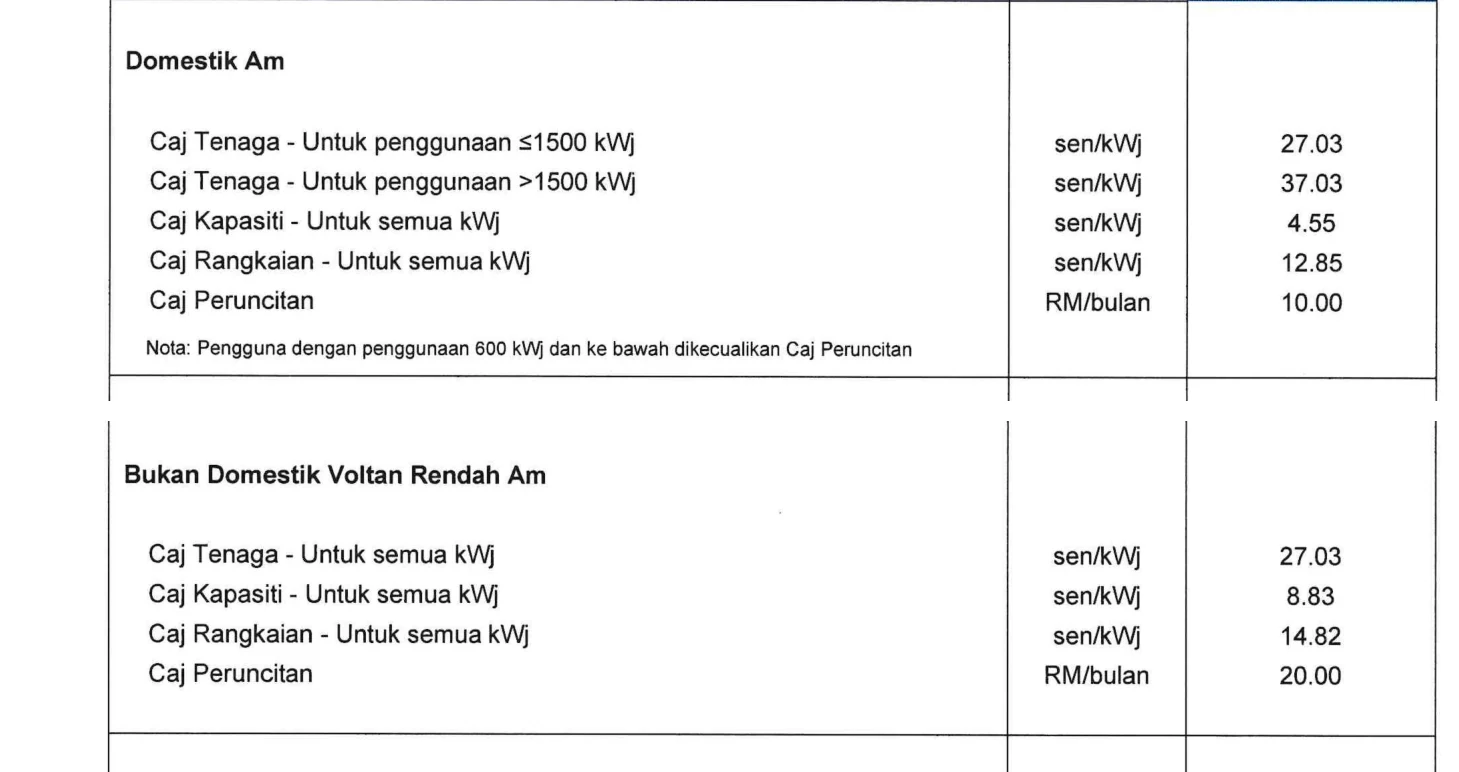
The rates tell the rest. From TNB’s published tariff schedule for Peninsular Malaysia, which runs from 1 July 2025 to 31 December 2027:
| Component | Domestic | Non-domestic, low voltage |
|---|---|---|
| Energy charge | 27.03 sen/kWh up to 1,500 kWh 37.03 sen/kWh above 1,500 kWh | 27.03 sen/kWh |
| Capacity charge | 4.55 sen/kWh | 8.83 sen/kWh |
| Network charge | 12.85 sen/kWh | 14.82 sen/kWh |
| Retail charge | RM10.00 a month | RM20.00 a month |
| AFA exemption | Yes, at or below the threshold | None, at any level |
| Service tax exemption | Yes, at or below the threshold | None, at any level |
At 800 kWh the arithmetic is blunt. A domestic account pays RM365.44 a month before AFA and before service tax. A low-voltage commercial account pays RM425.44 for the same 800 kWh. The gap is RM60, every month, and it is there before the AFA line is added at all.
There is a third difference for larger premises. Medium and high voltage tariffs price capacity and network as a charge per kilowatt of maximum demand rather than per kilowatt-hour: RM29.43 and RM59.84 per kW on medium voltage, RM16.68 and RM14.53 per kW on high voltage. Those two lines alone routinely outweigh the energy charge for a factory, and no part of the 17 September measure touches them.
What to check before 31 December
First, find your tariff class. It is printed on the bill, and it decides everything above. If the account is domestic there is nothing to apply for, because the exemption follows the meter reading. If it is commercial, the exemption question does not arise.
Second, the two levers TNB names for a commercial account are consumption and timing. Under the current structure the off-peak window for the time-of-use scheme runs from 10pm to 2pm Monday to Friday, and all day on Saturdays, Sundays and public holidays. Shifting load into it is a rate decision, not a rebate.
Third, note the date. The measure ends on 31 December 2026. The government has not said what the threshold becomes on 1 January 2027, and the tariff schedule itself runs to 31 December 2027. The two dates do not line up, which means anyone budgeting past year-end is budgeting on a number that has not been announced.
The bill you can control is the one you host. Every kilowatt-hour a business runs on its own premises is billed on a commercial tariff with no AFA exemption, no service tax exemption and a retail charge twice the domestic rate. The equipment that does not sit in your office does not sit on your meter either.
Big Domain is a Malaysian hosting and infrastructure provider. If you want to see what moving your servers off-site does to the non-energy part of that bill, start here: bigdomain.my/hosting — or talk to us at bigdomain.my/contact. Prefer to just ask a question? Message us on WhatsApp.
Sources
- Tenaga Nasional Berhad — Press release S.A. 2026/09/15_23 (HQ), “Addressing electricity bill concerns: AFA mechanism ensures transparency and fair cost-sharing since July 2025”, 15 September 2026. Opened 17 September 2026. https://www.tnb.com.my/assets/press_releases/20260915_23_bi.pdf — the source for the AFA start date, the rebate and surcharge history, the RM3.1 billion and RM0.8 billion totals, the RM435 million through the Electricity Industry Fund, the September 2026 rate of +3.67 sen/kWh, and the exemption of domestic users at 600 kWh and below from AFA, the 8% service tax and the retail charge.
- Tenaga Nasional Berhad — Jadual Tarif Elektrik di Semenanjung bagi Tempoh 1 Julai 2025 hingga 31 Disember 2027 (electricity tariff schedule for Peninsular Malaysia). Opened 17 September 2026. https://www.mytnb.com.my/tariff/PDF/jadual-tarif-elektrik-terkini-2-julai-2025.pdf — the source for every rate in the comparison table, including the domestic retail charge of RM10.00, the non-domestic low voltage retail charge of RM20.00, and the note that domestic users at 600 kWh and below are exempt from the retail charge.
- Bernama — “Electricity Bill Protection For Domestic Users Expanded To 800 Kwh – PM Anwar”, 17 September 2026. Opened 17 September 2026. https://www.bernama.com/tv/news.php?id=2608570 — the source for the 600 to 800 kWh change, the September to 31 December 2026 coverage, the three exemptions, the direct quotation from the Prime Minister, and the attendees at the Ministry of Finance meeting.
- Kerajaan MADANI / PETRA / Suruhanjaya Tenaga / TNB — announcement graphic, “Perlindungan Bil Elektrik Diperluas Kepada 800 kWj”, 17 September 2026. Reproduced above. Used for identification of the announcement and its scope; it is a government publication and its use here implies no endorsement, sponsorship or partnership.
What could not be checked. We could not open the Prime Minister’s own Facebook post directly, so the quotation is taken from Bernama’s report of it rather than from the post itself; three other Malaysian outlets carried the same wording on the same day. We also could not confirm, in a primary TNB or Energy Commission document, whether the AFA is applied to a household’s entire consumption once it crosses the threshold or only to the units above it. The figure of roughly RM29 in the table above assumes the whole 800 kWh. TNB’s customer guidance has been reported as applying the rate to the entire consumption, but no document we opened states this, so treat the size of that line as indicative and the rate itself, +3.67 sen/kWh, as the confirmed figure. Finally, the published TNB tariff schedule still reads 600 kWh, as it did before the announcement; we have not seen the schedule updated to 800 kWh, and the change is effective by the Prime Minister’s statement rather than by that document.
About BD Media. BD Media is the editorial desk of Big Domain, a Malaysian web hosting and digital services company. We write about the things a Malaysian business owner has to act on: tax, payroll, statutory contributions, e-Invoice and the digital tools that sit around them.
This article is a report on published government and utility statements, not advice on your own account. Check your bill, or ask TNB, before you act on it.