Xiaohongshu stopped being a niche Chinese app in Malaysia somewhere around the middle of 2026, when its business arm started running growth summits with the Malaysia-China Chamber of Commerce in Kuala Lumpur, Negeri Sembilan and Melaka. More than 300 entrepreneurs showed up across the three sessions.
What most of them did not get was a rulebook. Xiaohongshu enforces content rules that are stricter in places than Malaysian law requires, and it enforces them against copy most Malaysian marketers write without knowing there is a rule at all.
A new Malaysian-built tool set aims at exactly that gap. This is what it does, where it is genuinely useful, and where it stops.
Disclosure, up front: easyrednote.com is operated by Big Domain, the company behind BD Media. We are writing about our own product, and we have led with the parts that are compliance tools rather than the parts that are marketing hooks.
Xiaohongshu Malaysia: what gets a post throttled
The tool’s own working assumption is that about 40 per cent of notes with weak reach have a sensitive word in them. That figure is the vendor’s, not an audited platform statistic, but the categories it checks are specific and checkable.
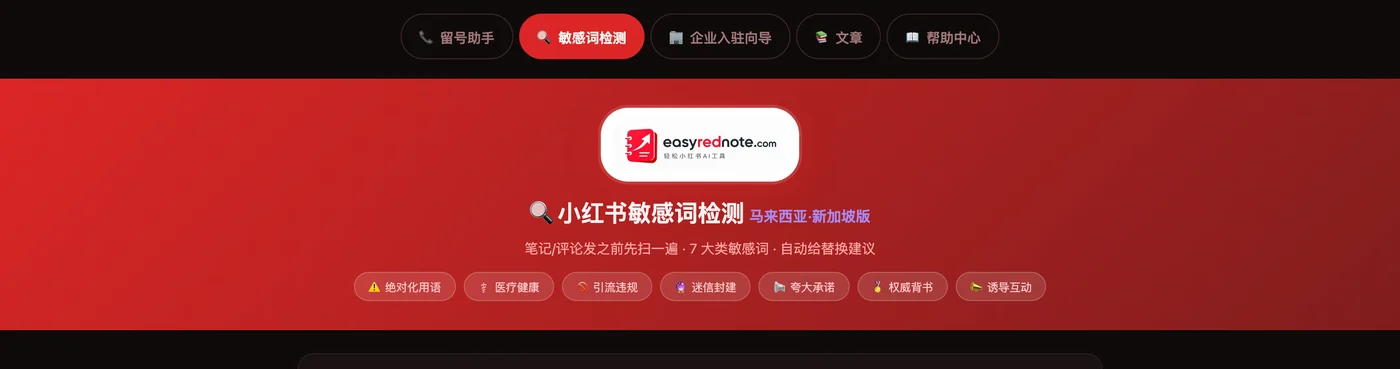
Seven categories apply to everyone:
| Category | What trips it | What to write instead |
|---|---|---|
| Absolute claims | Best, number one, 100%, only, top — anything unprovable as a superlative | Personal experience: “I found it worked well for me” |
| Medical and health claims | Whitening, spot removal, slimming, fat burning, anti-ageing on ordinary products | Soft descriptions: brightening, helps with oil control, personal results |
| Off-platform diversion | WeChat, phone numbers, QR codes, external links | In-platform calls to action: comment below, see my profile |
| Superstition | Fortune telling, feng shui, wealth attraction, blessing rituals | Remove, or reframe as culture or personal growth |
| Exaggerated promises | Money-back if it fails, guaranteed cure, results in one use | Tested personally; many users report; returns policy |
| Borrowed authority | FDA approved, doctor recommended, celebrity favourite, national TV | State only qualifications you can evidence, otherwise remove |
| Engagement baiting | Like to win, follow and I follow back, free giveaway, follow-for-follow | Invite a save or a genuine share instead |
Then there are industry-specific sets for recruitment, education, real estate, finance and investment, insurance, travel, matchmaking, and counterfeit goods — plus a privacy set covering ID numbers, bank card numbers and verification codes.
One of those categories is new enough that most Malaysian marketers have not heard of it. Since August 2026 the platform requires AI-assisted content to be declared. The tool’s reading of the rule is that failing to label is throttled for seven days, and three failures mean a permanent ban. Whether a Malaysian account is on the receiving end of that enforcement in practice is not something we could verify — but the direction is clear.
The Malaysia problem nobody warns you about
This is where a locally built checker earns its place, and it is the single most useful finding in the tool.
The generic Chinese banned-word lists miss how Malaysian accounts actually leak contact details. The tool carries a Malaysia and Singapore word library from version 5.0 that catches forms the standard lists do not: WhatsApp or “WA” followed by a full number, common misspellings like whatapps and telegram written as a variant, the Malay phrase “nombor saya”, and blog or Linktree links used as off-site redirects.
It also handles Malay-language numbers — kosong, satu, dua — and words like nombor and hubungi, which the platform’s semantic layer can read as an intent to hand over contact details even when written in Malay instead of Chinese.
That matters because the compliant answer is not the clever one. The tool’s own guidance for individual accounts is to use in-platform routes — a pinned note on your profile, a first image on Instagram — and to keep numbers out of the body text and the comments entirely. For businesses, it points at the enterprise account tools instead.
How the check actually works
- Paste the copy. The text is processed in your own browser. The tool states that copy is not uploaded to a server, which matters if you are checking client work under an agreement.
- Choose the context. Note body or comment section, and a strictness level — strict, standard or loose. A comment section is policed differently from a note body, so checking both matters.
- Read the risk colour. Red means a hard banned word such as a medical claim, an absolute or a diversion term. Amber means a soft term or a suspected one. Green means nothing obvious matched.
- Fix and re-run. Every flagged category carries a suggested replacement. Change them and check again until it reads green.
The vendor is also honest about the exclusions problem that ruins naive checkers: words like “first” appear in harmless contexts such as “the first day” or “my first cup”, so the checker runs an exclusion list to cut false positives. A checker that flags ordinary speech gets ignored within a week.
The part that actually changes your reach: an enterprise account
Cleaning your copy stops you being throttled. It does not get you distribution. For that, the platform’s own answer is the enterprise account, and this is where the tool’s second module is aimed.
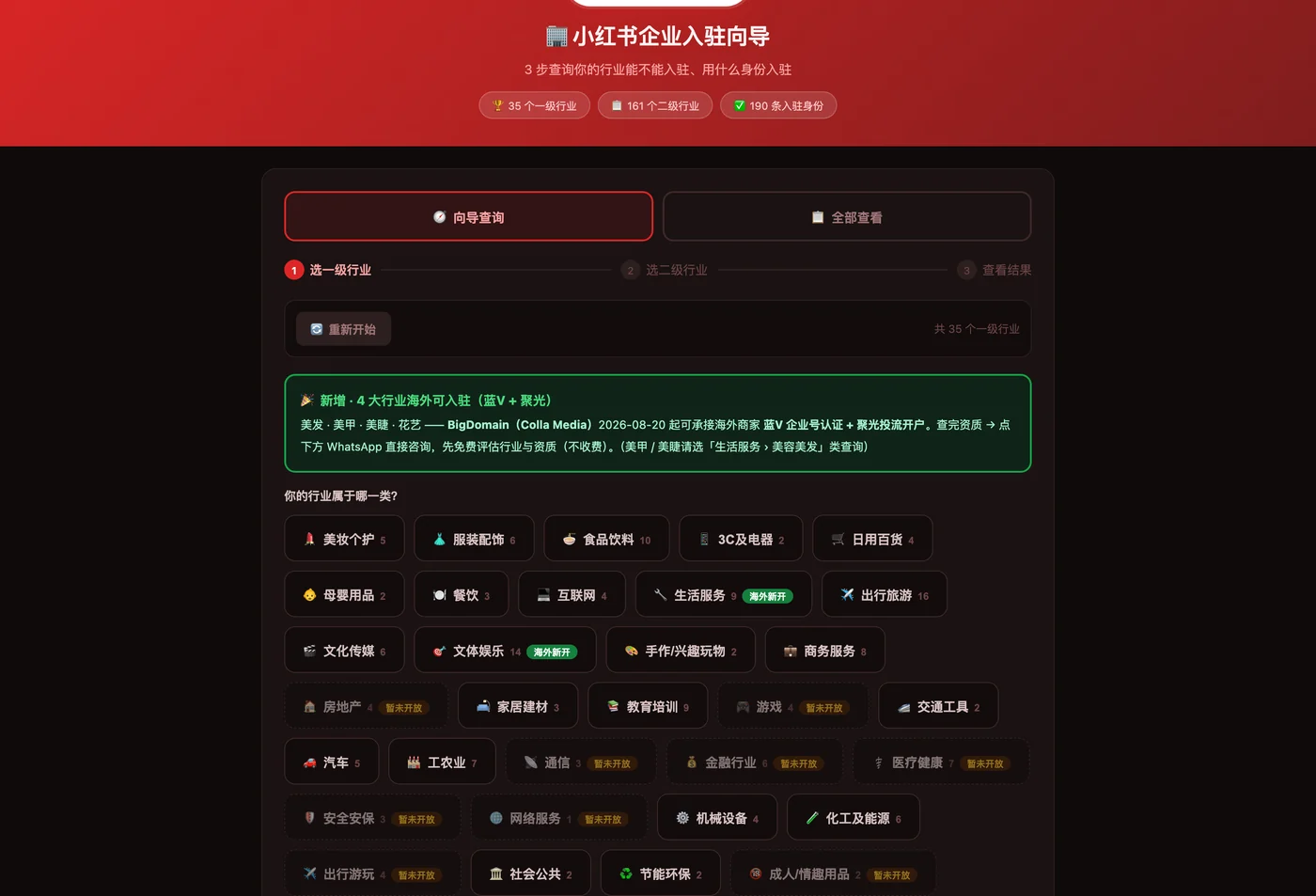
The wizard checks whether your industry and your entity type can obtain a Xiaohongshu enterprise account — the blue-V professional account — and whether it can advertise. It covers 35 first-level industries, 161 second-level industries and 190 onboarding identity types.
Two structural facts matter more than the wizard itself, and both catch Malaysian businesses out:
Overseas entities cannot open an advertising account by themselves. Since 2 February 2026, overseas entities including Malaysian and Singaporean companies have had to go through an overseas agent, which submits the qualification file for the platform’s invited-industry approval. If you assumed you would sign up and start spending, that assumption is wrong.
Blue-V certification runs at RMB 600 a year, and the paperwork is unforgiving. Malaysian applicants file SSM registration documents — Form 9 or the latest annual return. Singaporean applicants file ACRA documents. The platform requires colour scans, all four corners present, and a company seal on every page. Electronic seals are not accepted. If the person operating the account is not the legal representative, a sealed authorisation letter is required.
| Item | Detail as published by the tool |
|---|---|
| Blue-V certification fee | RMB 600 per year |
| Malaysian entity documents | SSM registration — Form 9 or the latest annual return |
| Singapore entity documents | ACRA registration documents |
| Format rules | Colour scan, clear, all four corners, company seal on every page. No electronic seals. |
| If the operator is not the legal representative | A sealed authorisation letter including the operator’s signature and contact details |
| Industry-specific extras | Food business licence, cosmetics filing, medical device filing, trademark certificate, depending on category |
| Advertising account, overseas entities | Cannot self-open since 2 February 2026. Must go through an overseas agent with invited-industry approval. |
| First top-up via an agent channel | Generally RMB 2,000 to 5,000, depending on the agent |
| Risk deposits | 68 second-level advertising industries carry deposits — medical aesthetics RMB 100,000, dental RMB 30,000 to 80,000, real estate RMB 30,000 to 100,000, finance and legal RMB 30,000 to 50,000 |
Four more industries became available to overseas entities on 20 August 2026 — hairdressing, nail salons, eyelash studios and floristry. That is the kind of opening that is worth knowing about early, because the categories that are closed are closed for structural reasons and do not usually reopen quickly.
Where this tool stops
Three honest limits, two of them stated by the vendor itself.
No checker guarantees safety. The word library updates and category sensitivity differs between verticals, so passing a check reduces the risk of a throttle rather than eliminating it. The tool says this directly. For anything commercially important, a second check through the platform’s own tools or a human reviewer is still the safer path.
Passing is not reach. A green result means you will not be removed or limited for a banned word. It says nothing about whether the note performs — that still comes down to the content, the cover, the title and the timing.
The verification we could not do. We did not verify the 40 per cent figure against platform data, and we could not confirm from an official Xiaohongshu source how the August 2026 AI-labelling rule is enforced outside mainland China. Both are stated here as the vendor’s position, not as platform policy.
What a Malaysian marketer should take from this
The rule that matters most is not technical. It is that Xiaohongshu’s restrictions assume a Chinese operating environment, and Malaysian accounts routinely break them by accident — with a Malay number word, a WhatsApp handle, or a superlative that would be unremarkable in an English ad.
Check the copy before you post. Then decide whether an enterprise account is worth the paperwork, and start that process early, because the overseas route has an approval step that you cannot hurry.
Getting an enterprise account for your industry
Big Domain is an All Value (Youzan) official e-commerce partner and an EasyParcel logistics partner, and works with overseas merchants on Xiaohongshu onboarding, store opening and advertising account activation. The industry and qualification review is free.
About BD Media
BD Media is the editorial desk of Big Domain. We write about the rules and platforms Malaysian businesses have to work with, and we name our sources so you can check them. Where we are writing about a Big Domain product, we say so at the top.
Sources
- easyrednote.com, sensitive-word checker, retrieved 18 September 2026 — easyrednote.com/sensitive.html. The seven general categories, the industry-specific sets, the risk colour meanings, the strictness levels, the note-versus-comment context, local browser processing, the Malaysia and Singapore word library from version 5.0, the AI-labelling rule and its stated penalties, and the vendor’s own statement that the check is not a guarantee.
- easyrednote.com, enterprise onboarding wizard, retrieved 18 September 2026 — easyrednote.com/wizard.html. Coverage of 35 first-level and 161 second-level industries and 190 identity types, the RMB 600 annual certification fee, the Malaysian and Singaporean document requirements, the format and company-seal rules, the 2 February 2026 change on overseas advertising accounts, agent top-up ranges, risk deposits, and the four industries newly opened to overseas entities on 20 August 2026.
- New Straits Times, “Malaysia SMEs turn to digital platforms to tap China’s travel recovery”, July 2026 — nst.com.my. The Xiaohongshu Business and Malaysia-China Chamber of Commerce summits across three cities, more than 300 entrepreneurs attending, MDEC support, and the platform’s stated interest in Malaysian brands.
- PR Newswire Asia, Xiaohongshu Business and MCCC summit release, 14 July 2026 — en.prnasia.com. The official account of the same summit series, including the Kuala Lumpur session on 27 June and the regional commercial messaging.
- Swinburne University of Technology Sarawak, “2026 Xiaohongshu NEW Ways to Play” workshop, 22 January 2026 — swinburne.edu.my. Independent confirmation of the platform’s Malaysian outreach, including the blue-checkmark verification topic and its advertising and creator tooling.
Not verified: the 40 per cent figure for low-reach notes with sensitive words, and how the platform enforces the August 2026 AI-labelling rule outside mainland China. No official Xiaohongshu source for either was reached, so both are attributed to the tool rather than stated as platform policy.