Alibaba.com’s president told 15,000 buyers in Los Angeles that the future of B2B is A2A — agent doing business with agent. That was 9 September 2026. Within three weeks, Alibaba’s AI sourcing agent passed ten million monthly users, its buyer-side agents were holding twenty supplier negotiations at once, and a 29-year-old in Zhejiang was running an export business with eight agents and no staff. The shift is not a forecast. It is in production, with numbers.
A Chinese edition of this article is available: B2B 正在变成 A2A:智能体成为新买家.
Nine days later, on 18 September, at the fifth Shandong Cross-Border E-Commerce Fair in Jinan, Alibaba International’s vice president Liu Guangjun (刘光俊) put the same judgement to a hall of exporters: cross-border e-commerce is moving “from the B2B era to the A2A era”, and the next stage is a period of agent-to-agent collaboration in which a merchant issues a business instruction and AI completes the whole process, with the exchange of information and the matching of deals between agents further lowering the threshold for global trade. That statement is carried by the China News Service report linked in the sources below — reported at the fair, not issued by us. Alibaba’s own data explains why the shift is happening: increasing numbers of overseas buyers no longer type keywords into a search box. They describe the requirement in plain language, upload a photograph or a PDF, and let an AI complete discovery, product refinement, supplier screening, terms negotiation and order management. Overseas buyers using AI multimodal search on the platform grew traffic by more than 132%.
The next buyer is not a person scrolling a feed. It is an agent reading your site at two in the morning, deciding whether you belong on the shortlist. Authority is the only thing it can measure.— Dr Henry Tye, founder of BigDomain
What agentic commerce actually means
A2A — agent-to-agent — means the buyer’s AI agent and the seller’s agent negotiate directly: sourcing, comparison, quotation, terms. Alibaba’s leadership uses that term specifically. A2B, which I use, is the same shift described from our side of the table: the agent is now the party you must satisfy, and it is not a person.
Be clear about what it is not. This is a division of labour, not a transfer of authority — and the restraint comes from the product design rather than from a slogan. Alibaba’s own launch documentation states that high-stakes actions involving finances or file access require explicit user approval, that agents run in sandboxed environments under granular permission management, and that users can choose not to have their data saved on Alibaba’s servers. The commercial terms stay with people. The coordination is what the agent absorbs.
Their product behaves that way. In the Accio Sourcing Toolkit the agent runs supplier conversations around the clock and can hold twenty at once, negotiating price, sample costs, lead times, minimum order quantities and shipping terms, and reusing one supplier’s best terms as leverage with another. It cannot close. The buyer still approves pricing, commercial terms and purchase orders; payments need explicit confirmation.
Alibaba’s president, Zhang Kuo, has offered a sharper test for whether a business has genuinely become AI-native, and it is the test I would apply to a Malaysian SME. The measure is not how much time an AI saves. It is whether AI lifts revenue per head, whether it improves the speed and quality of decisions, and how many of a company’s processes reach what he calls L4 automation — where the work is executed by the AI and the person’s role is to evaluate what the AI has done. Reported by 亿邦动力 from his keynote, July 2026. On that test most businesses have barely started, and the distance between those that have and those that have not is the commercial story of the next three years.
The proof: this is measured, not predicted
A single vendor’s claim is not evidence. What follows is every independent forecast and measurement I could find that bears on the same question, so you can judge the direction for yourself. Where two organisations disagree I have said so rather than picking the flattering number.
| Source | Finding |
|---|---|
| Gartner, Top Strategic Predictions 2026 | By 2028, 90% of B2B buying will be mediated by AI agents, routing more than US$15 trillion in global spend |
| Forrester, 2026 B2B predictions | By the end of 2026, one in five B2B sellers will face quote negotiations led by AI buyer agents |
| Deloitte, surveyed with WSJ | 38% of B2B buyers already use agentic AI somewhere in their purchasing process |
| PwC, Digital Trends in Operations 2026 | 83% of operations leaders expect AI agents to break down traditional functional silos, yet only 27% have fully embedded an AI strategy across business units |
| Salesforce, State of Sales 2026 | 87% of sales organisations use AI; 54% of sellers have already used an AI agent — not a chatbot, an agent; 88% plan to by 2027. Among leaders with agents in production, 94% call them critical |
| Gong Labs, 7.1m opportunities across 3,613 companies | Teams using AI heavily generate 77% more revenue per representative; 70% of enterprise revenue leaders now trust AI to make business decisions on its own |
| Boston Consulting Group, February 2026 | A US$200 billion agentic AI opportunity for technology service providers |
| Cloudflare | Automated agent and bot traffic crossed 50% of all internet traffic in June 2026 — 57.4% of requests on its network, a crossover its chief executive had not expected until 2027 |
| McKinsey, B2B Pulse | B2B buyers use an average of 10 channels to complete one purchase decision, and broken cross-channel context is the leading cause of stalled deals — the exact problem an agent does not have |
Two of those deserve emphasis. The Deloitte figure — 38% already buying — is a present-tense number, not a projection; it means roughly two in five of your business customers have already delegated part of their purchasing to software. And the PwC figures matter for a different reason: 83% of operations leaders already expect AI agents to dismantle the functional silos they work inside, yet only 27% have embedded an AI strategy. The appetite is well ahead of the plumbing. The constraint was never capability.
Google’s answer is a standard, not a product. Google announced the A2A protocol on 9 April 2025, donated it to the Linux Foundation two months later, and shipped the first stable specification, A2A v1.0, in March 2026. Founding members included AWS, Cisco, Microsoft, Salesforce, SAP and ServiceNow. Support has grown from 50 organisations to more than 150, spanning every major hyperscaler. Microsoft has integrated it into Azure AI Foundry and Copilot Studio; AWS has embedded it in Bedrock AgentCore; Deloitte has connected more than 1,000 pre-built industry agents to it. In August 2026 A2A joined the Agentic AI Foundation, the Linux Foundation body formed in December 2025, putting it under the same roof as Anthropic’s Model Context Protocol and OpenAI’s AGENTS.md.
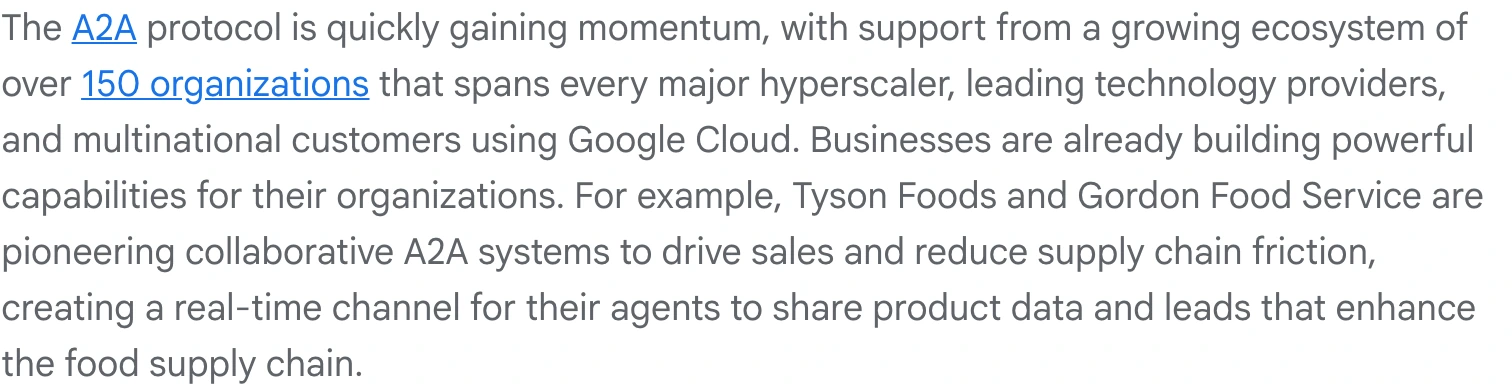
Google’s own A2A developer announcement: support from over 150 organizations. Source: Google Cloud blog
As organizations move multi-platform agentic systems into production, interoperability is becoming essential. A2A enables agents to easily discover, delegate, and collaborate across frameworks and siloed platforms, without custom integrations.— Rao Surapaneni, VP and general manager, business application platforms, Google Cloud, at the announcement that A2A was joining the Agentic AI Foundation, 17 August 2026
The executive director of the Agentic AI Foundation, Mazin Gilbert, is blunter about where this ends up. Asked whether vendors will really let their agents cooperate, he said interoperability “is as much a market commitment as a technical achievement”, and that “neutral governance is critical” because companies should “compete on agent quality and earn customer loyalty through performance, not technical barriers”. On the timeline: “We are already building the Internet of Agents.” And this: “Agent traffic has already exceeded human traffic on the internet.” He expects that within three to five years there may be more agents operating than people.
Gartner says the same thing, and adds the detail that matters most to anyone who earns a living from search. In its top strategic predictions for 2026 and beyond, Gartner forecast that by 2028, 90% of B2B buying will be AI agent intermediated, pushing over US$15 trillion of B2B spend through AI agent exchanges. In the same prediction, Gartner states that traditional SEO and pay-per-click will give way to agent engine optimization, that products will need to be machine-readable, and that procurement will shift to autonomous machine-to-machine transactions.
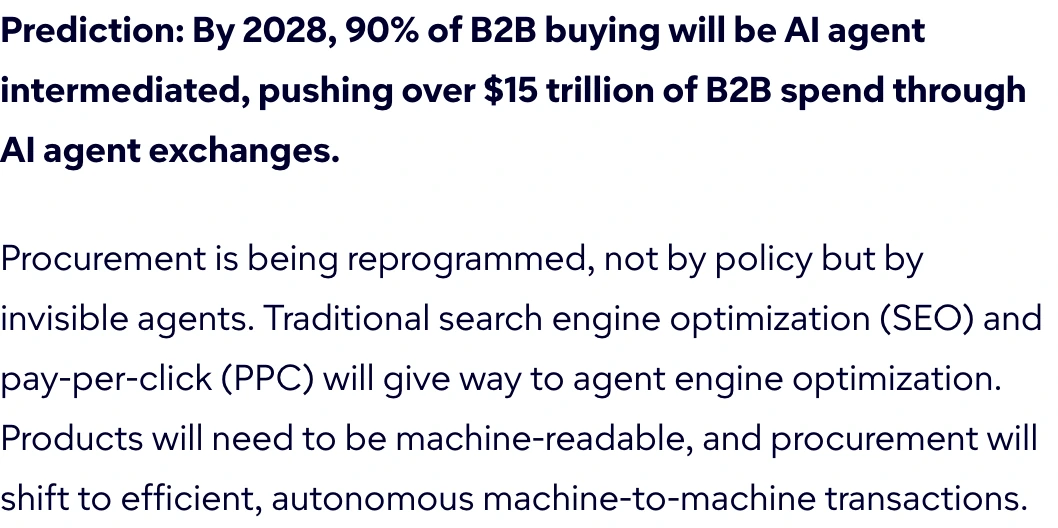
Gartner’s own prediction, in full. Note the second half: traditional SEO and PPC giving way to agent engine optimization. Source: Gartner, Top Strategic Predictions for 2026 and Beyond
There is an honest caveat inside Gartner’s own numbers. In the briefing, Gartner Fellow Daryl Plummer noted disagreement within Gartner itself about when agent exchanges would emerge — which is worth more than a confident date. His framing of the competitive question is the line I would put on a wall: “You don’t have to worry about losing your job to AI. You have to worry about losing your job to someone who uses AI better than you do.”
And it is already deployed, not just predicted. Tyson Foods and Gordon Food Service are running collaborative A2A systems so their agents can share product data and leads across the food supply chain. In China, Huawei has standardised A2A as the protocol between Celia, its HarmonyOS assistant, and in-app agents — and Tencent’s WeChat is among the first major applications integrating with Huawei and other Android makers’ assistants through A2A. When the country’s dominant messaging app wires its assistant to an agent standard, that is infrastructure, not a pilot.
China is where the evidence is thickest
If you want proof rather than prediction, look at what Chinese sellers have already done, because the platforms there wired agents into the sales process first.
Amazon reported in June 2026 that more than 98% of surveyed Chinese sellers use AI tools in store operations, and 16% have moved beyond single-point tools to deploying AI workflows or agents. That second number is the one to watch — it is the transition from “using AI” to “AI doing the work”.
Alibaba’s own agent, Accio, launched as a sourcing engine in November 2024 and was relaunched as Accio Work in March 2026. Its reported trajectory is the clearest available picture of agent adoption at scale. These are Alibaba’s figures, so read the direction rather than the decimal point.
| Metric | Reported |
|---|---|
| Monthly active users | Over 10 million globally (March 2026) |
| User growth in one year | More than 30x |
| Who they are | 40% are one-person businesses |
| Token consumption | 6x in four months; 10x across a year; per-task cost down 50% |
| Version releases in the first 122 days | About 100 |
| Paid merchants | Over 50,000 |
| Buyers on AI multimodal search | Traffic up more than 132% |
| Buyers using AI Mode who form valid business opportunities | 5x faster |
| Platforms connected | Alibaba.com, 1688, Taobao, Tmall, Pinduoduo, JD, Douyin, Shopify, Amazon, eBay, Temu, TikTok Shop |
Zhang Kuo framed the same shift in cost terms at CoCreate, and it is the line I would hand to any Malaysian SME weighing an AI subscription:
For a small business, an AI that is too expensive to dare use every day is no different from having no AI at all. Our goal is not just to make AI stronger — it is to make commercial AI genuinely practical and genuinely affordable.— Zhang Kuo (张阔), President of Alibaba.com, CoCreate 2026, Los Angeles, 9 September 2026
The marketplace effect is where a Malaysian exporter feels it. At Alibaba’s March 2026 trade event, new overseas buyers rose 40% year on year, deep inquiries rose 31%, French orders grew 50% on top of a 109% gain the previous year, and Brazilian orders rose 136%. Sellers using the platform’s AI assistant converted new opportunities at 19% — eleven percentage points above the traditional route — and AI-enhanced listings drew 60% more deep inquiries.
The human proof point. Zhang Qianchao, born in 1997 in Lishui, Zhejiang, runs eight agents on Accio covering market research, product design, development, policy interpretation and customer reception. The selection-and-design cycle that used to take two to three weeks now takes one day. In under two months he sold more than 3,000 baseball caps to buyers in Europe, the US and Africa. He is not a technology company. He is one person with an agent team.
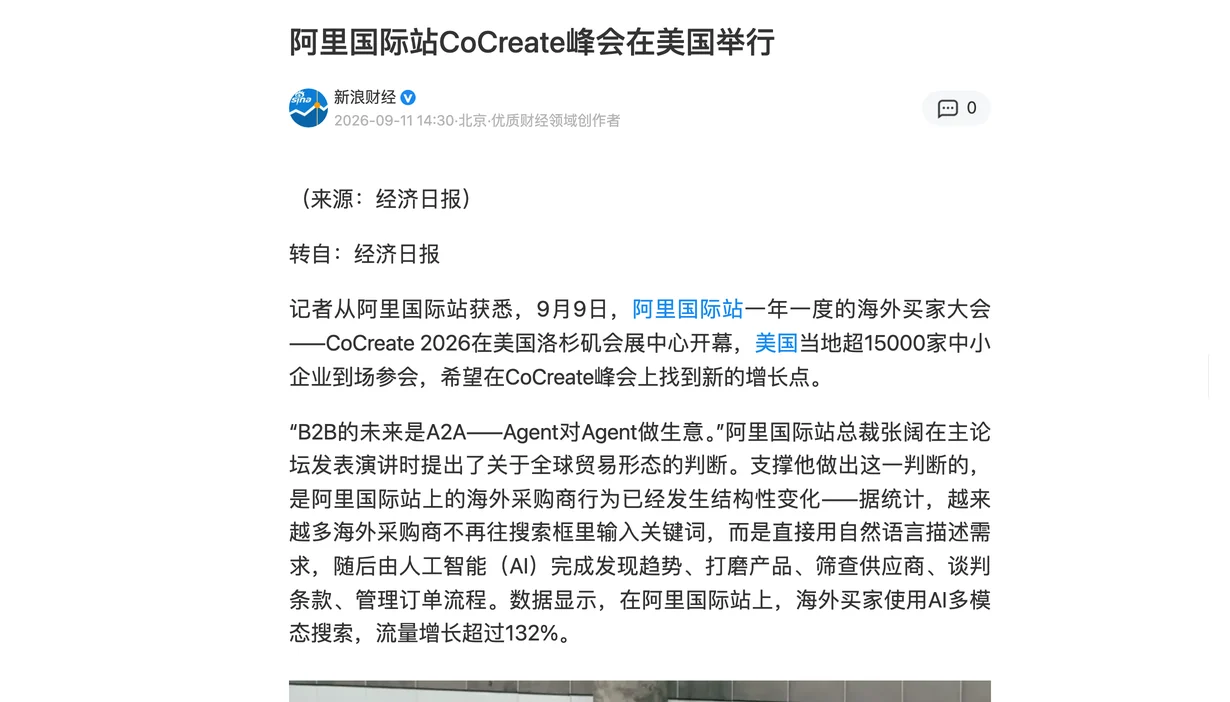
The Economic Daily report of CoCreate 2026 carrying Zhang Kuo’s line: “The future of B2B is A2A — Agent doing business with Agent.” This is a crop of the report text, not a photograph of anyone. It shows the headline, the Sina Finance byline dated 2026-09-11, and the two provenance lines “(来源:经济日报)” and “转自:经济日报”, so the sourcing is visible in the image itself. Only the site’s own page furniture — a mobile app-upgrade card, a reader-toolbar and a right-margin promotion — has been removed; no article text was altered. Text source: 经济日报 (Economic Daily), September 2026
The infrastructure proof point. In September 2026 Alibaba open-sourced CommerceAgentBench on GitHub — a benchmark built from ten million active SME users, 1.6 million real conversations and 200,000 execution traces, distilled into 107 real end-to-end commercial tasks. Open-sourcing a benchmark is a strange thing to do if the capability is marketing. It is a normal thing to do if you want the field measured honestly.
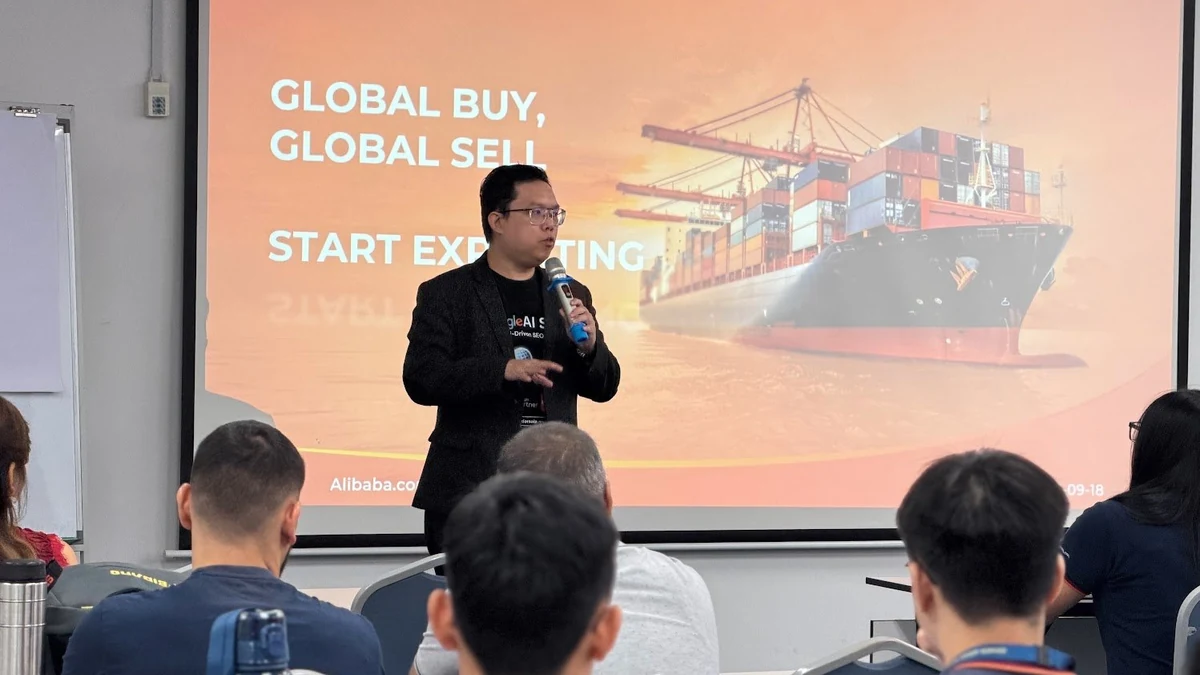
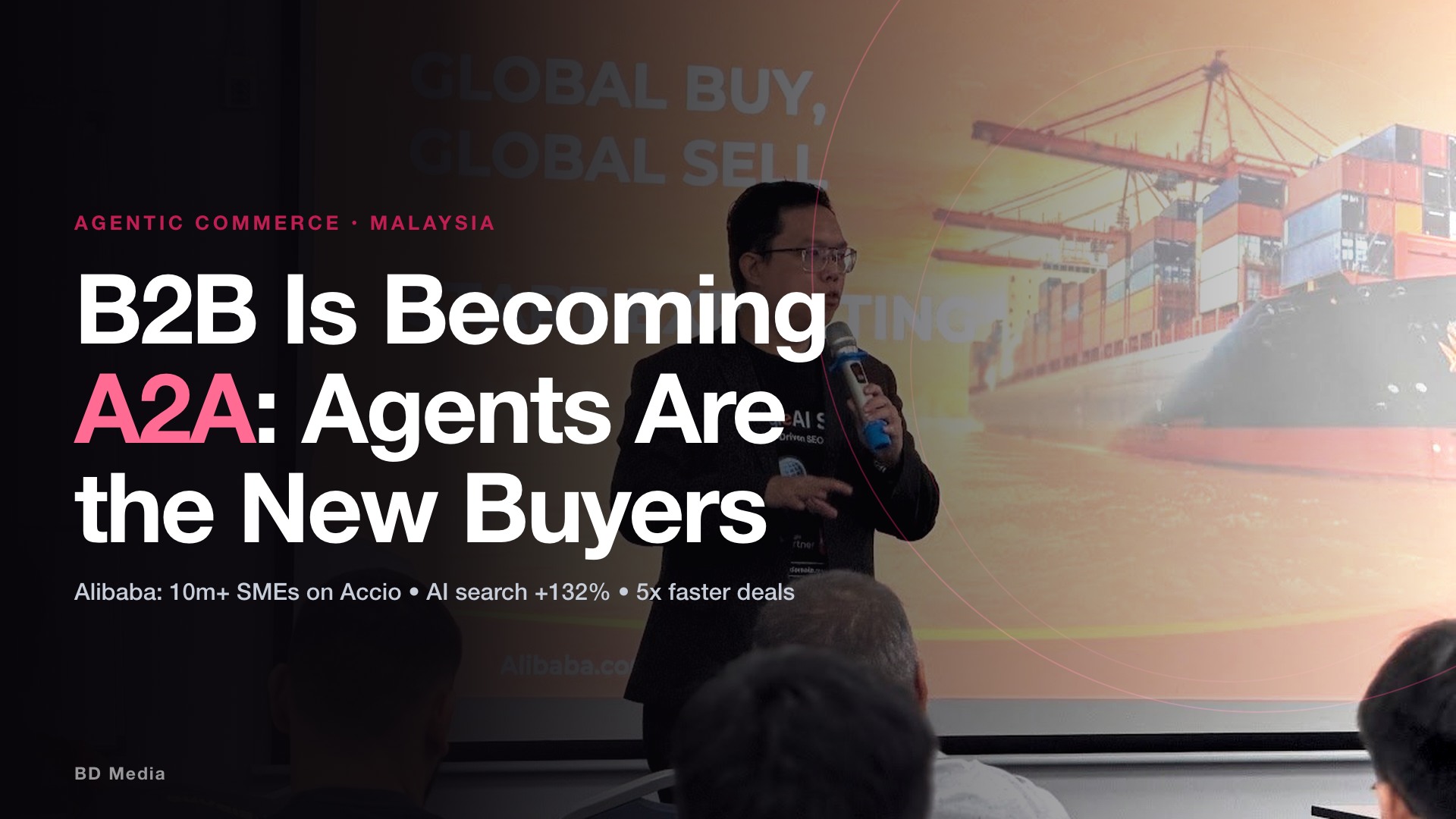
Presenting on global buy, global sell and starting to export, at an Alibaba.com session. Photo: Dr Henry Tye
Search did not die. It changed shape
I am asked this in every room I speak in — at Alibaba.com export sessions for Malaysian sellers, on stage at UOW Malaysia, in Mandarin to entrepreneurs’ academy cohorts: has AI search killed SEO? No, and the mechanics say why. Generative engines retrieve from an index, and the classic crawl feeds that index. Google’s AI systems, Perplexity and ChatGPT’s live search all pull from pages that had to be crawled, indexed and trusted first. A site that cannot be crawled is invisible everywhere, not just in the blue links.
But ranking no longer guarantees being quoted. The numbers:
- Roughly 68% of Google searches end without a click (SparkToro, 2026). If you are not named in the answer, you did not exist in that interaction.
- AI Overviews appear on about 48% of queries (BrightEdge tracker, March 2026) and cut click-through on the top organic result by 58% — up from the 34.5% Ahrefs measured when the feature first launched (Ahrefs, February 2026). The suppression is worsening, not settling.
- Roughly 90% of ChatGPT citations come from pages outside the top 20 organic results for the same query. Ranking and citation are different games with different scoring rules.
- On Similarweb’s 2026 AI Brand Visibility Index, 35% of US consumers start their product discovery with an AI tool and 13.6% with a search engine. Treat that one with care, because the research genuinely disagrees: Razorfish’s May 2026 study of recent major purchases put it the other way round — 36% starting with a search engine against 13% with AI — and YouGov found 86% of online searchers had used a search engine in the past 30 days against 25% using an AI assistant. What is not in dispute is the direction, only the speed. Search still closes the final mile; AI increasingly assembles the shortlist that mile runs on.
The labels layered on top of SEO describe real surfaces even where the industry oversells them: SEO ranks you, AEO makes you the direct answer, GEO gets you cited inside a generated answer, and agentic SEO makes you usable by an agent that has to act — compare, verify, request a quote, place an order. Several practitioners will tell you privately these are four names for one body of work. That is half right, and I say half deliberately, because the half they skip is the half that costs money: the foundation is shared, but the output changes at each layer — and a business that skips the foundation buys none of the four.
What earns a citation is unglamorous and measurable. Princeton, Georgia Tech and IIT Delhi found structured content earned 30–40% higher visibility in AI answers, while keyword stuffing performed below baseline. Kevin Indig’s analysis of 18,012 verified citations found 44.2% of citations come from the first 30% of a page, and that cited passages were twice as likely to contain a question mark — with 78.4% of question-linked citations coming from the headings. Answer early, date the page, name a human author, and put the number in the sentence.
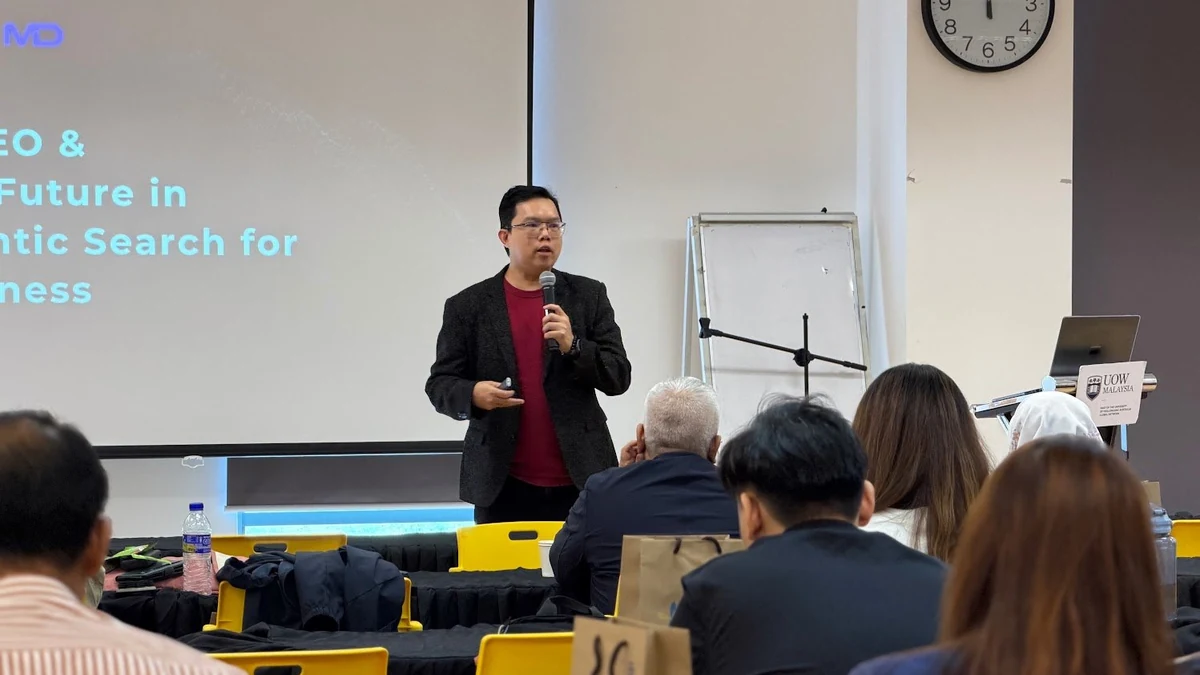
Speaking on SEO and the future of agentic search for business. Photo: Dr Henry Tye
Why web authority now outranks social exposure
This is the argument I make to every Malaysian business owner who asks whether to spend on their website or on social media, and I will put it in the plainest terms I have.
Social media rents you exposure. Your own domain builds you authority. Exposure vanishes the moment the algorithm changes its mind; authority compounds, and it is the only asset an AI agent can read, verify and cite at two in the morning.— Dr Henry Tye, founder of BigDomain
The evidence does not support treating them as equals, and the numbers below are what convinced me — not the other way round.
Owned web property is the anchor. Yext’s October 2025 analysis of 6.8 million AI citations across ChatGPT, Gemini and Perplexity found that 86% trace back to sources a brand controls or can directly influence — its own website (44%), its listings (42%), and reviews and social (8%). Only 6% came from news, forums and everything else. Gemini draws 52.1% of its citations from websites; OpenAI leans on listings at 48.7%. A second study of 178,000 citations put the brand-controlled share higher still, at 91%.
Third-party mentions are the multiplier. Ahrefs’ December 2025 analysis of 75,000 brands found branded web mentions correlate 0.664 with AI visibility, against 0.218 for backlinks — with branded anchors at 0.527 and branded search volume at 0.392. Those coefficients are not a ratio scale, so 0.66 is not “three times” 0.22; the finding is the ordering, and the ordering is unambiguous. Two caveats the researchers raise themselves: established brands accumulate mentions and AI visibility for the same underlying reasons, and on Perplexity and ChatGPT the same research found the correlation falls away sharply. Mentions predict AI visibility better than links do — but a correlation is a clue, not a mechanism.
Social only counts when a machine can parse it. Where social contributes it is long-form and text-rich: LinkedIn articles, YouTube transcripts, substantive public posts. Short captions, Reels and carousels are effectively invisible to retrieval systems, and there is a real pattern of brands with large follower counts and near-zero AI citation. YouTube is the exception and it is growing: its share of AI citations rose 158% in eleven months.
The honest complication. The research genuinely disagrees. One major study found 94% of AI citations came from non-brand-owned sources, with a university team concluding the preference for earned media over owned content is structural. Another analysis found owned brand pages losing citation share by 10% while creator content grew 140%. My reading is that they measure different things — one counts every citation including news-heavy categories, the other counts brands actively managing their own content and treats business listings generously as “controlled”. The conclusion survives the disagreement: own the page that answers the question, then get other people to say you did.
Let the agents in — and stop allowlisting only the popular ones
I watch a self-inflicted wound spread across corporate websites, and I have stopped being diplomatic about it: companies block AI crawlers, then spend on advertising and PR to buy back the visibility they deleted. The trade is measurable and one-directional: a Wharton and Rutgers study of publishers who blocked LLM crawlers found a 7% weekly traffic loss within six weeks — an earlier revision put it higher for large publishers — with no offsetting protection found anywhere in the business. A separate audit found 70.6% of blocking sites were cited by AI engines anyway.
The specific mistake competent teams make is allowlisting the bots they have heard of. It fails five ways.
| The mistake | Why it fails |
|---|---|
| You listed the well-known crawlers | One provider’s search-indexer coverage went from 4.7% of sites to over 55% in about a year while its training crawler fell from 84% to 12%. The category splits faster than any list you write |
| You allowed by name | User-agent strings are self-declared; anyone can claim to be a reputable bot. Verification means reverse DNS against published IP ranges — and one major vendor publishes none |
| You assumed agents announce themselves | Agentic browsers send standard browser signatures, because at protocol level they are a person browsing. User-agent rules cannot isolate them without blocking real visitors |
| You assumed the buying agents are covered | Agentic shopping and procurement bots have no stable robots.txt token. The bots that would buy from you sit outside the allowlist system entirely |
| You trusted the file | A missing rule means allowed, so an allowlist is the wrong shape — the correct posture is allow by default with targeted blocks. The asymmetry is the point: reported crawl-to-refer ratios run as high as 700:1, and above 11,000:1 for one major vendor’s crawler — hundreds of requests for every visit sent back |
Cloudflare, which sits in front of a large share of the web, learned this expensively. Having launched pay-per-crawl in 2025, in July 2026 it moved to paying publishers per citation. Their line is worth keeping: “a crawl is not the same thing as value delivered. A bot can fetch your page a thousand times and cite it zero.”
What this means for Malaysia
Malaysian buyers are already behaving this way — the difference is that most Malaysian sellers I meet have not adjusted. The evidence that matters is commercial, not anecdotal: the buyers arriving through AI-mediated search convert better and inquire deeper. On Alibaba’s own numbers, sellers using its AI assistant converted new opportunities at 19% against 8% on the traditional route, and AI-enhanced listings drew 60% more deep inquiries.
That gap is the whole argument. When the buyer is an agent, the seller who has made their specifications, prices, certifications and lead times readable wins the shortlist before a human is involved. The seller who has not is simply not in the pile — and there is no error message to tell them.
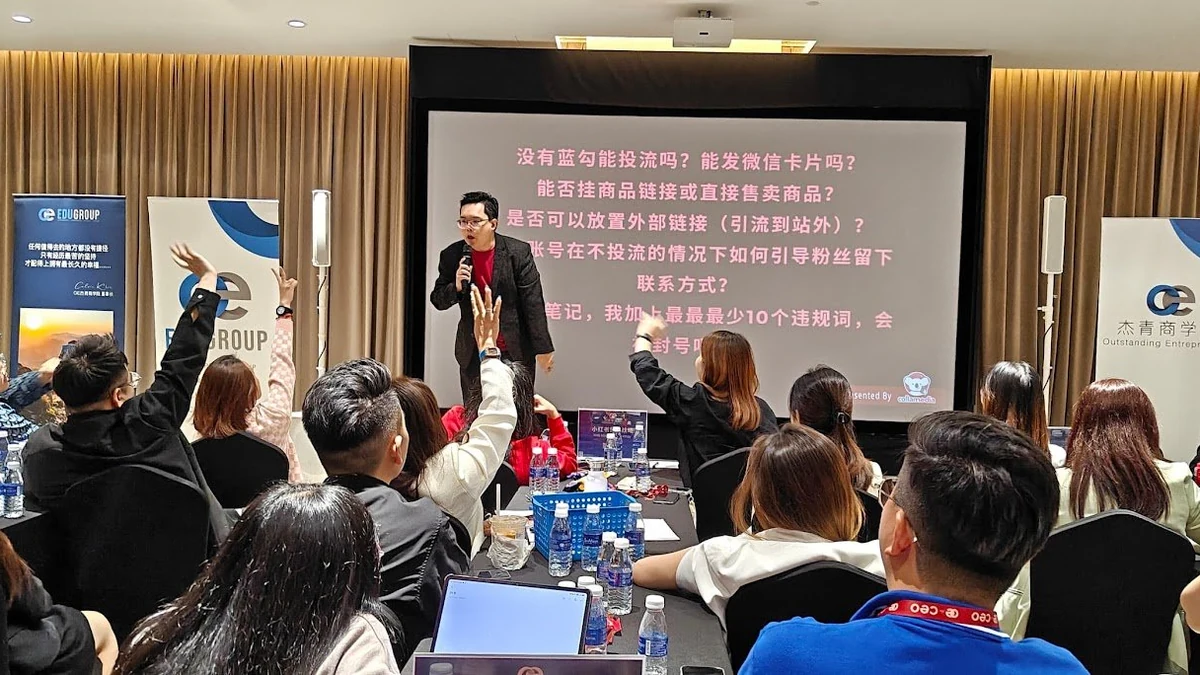
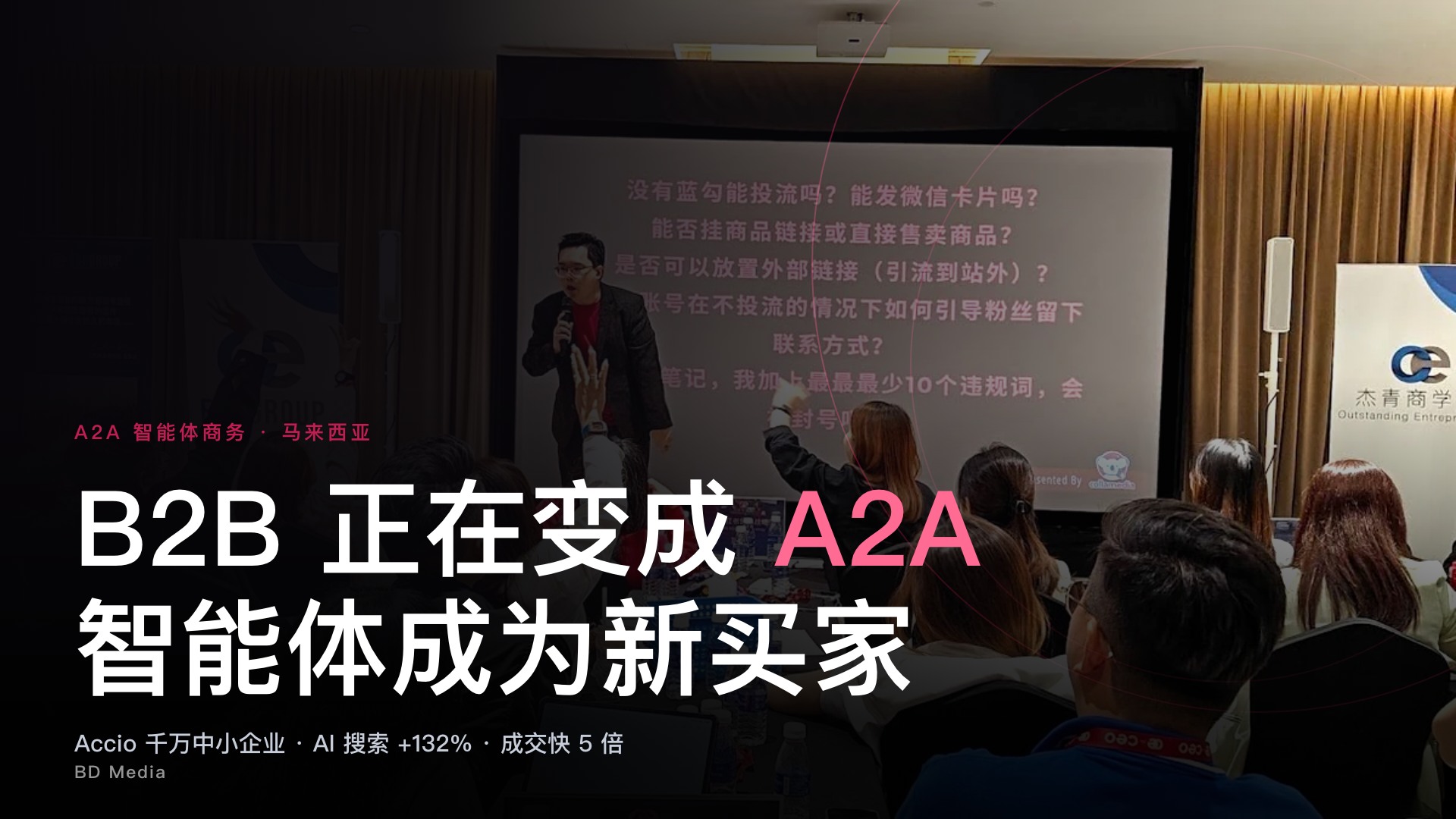
Speaking to an entrepreneurs’ academy cohort in Mandarin. Photo: Dr Henry Tye
What to do about it
The five actions I would take before signing with any AI vendor this year.
- Make your site machine-readable. Clear entities, one topic per page, structured data, the answer in the first third, a visible date, a named author. This earns citations and it is the same work as good SEO.
- Publish the facts you own — prices, specifications, certifications, lead times, minimum order quantities. An agent cannot shortlist what it cannot read. Tables inside PDFs and images are invisible.
- Check your crawler policy today. Read your own robots.txt, then cross-check your firewall and CDN, because those override it. If a CDN default blocked retrieval bots you get no error message, just silence.
- Build third-party corroboration. Press coverage, industry directories, review platforms, association mentions. Branded web mentions correlate more strongly with AI visibility than backlinks do — the ordering is the finding, not the size of the gap.
- Keep your own domain as the system of record. Social reaches people. Your site is what the agent reads when the decision is made.
The practical read
My advice is to treat A2A as a change in who reads you, not in what you sell. An agent does not respond to a brand story; it responds to specificity it can verify and structure it can parse. That is easier for a well-run Malaysian SME than for a company selling fog, because your specifications and prices are real facts already sitting on your website — just not in a form a machine can use.
I would rather tell you the work is unglamorous, because it is, and it compounds: get crawlable, get structured, get named, then get other people to name you. The businesses that do it will be cited, shortlisted and chosen, including by the agent doing the choosing. The ones that keep paying for exposure while their own domain stays unreadable will find the shortlist was decided without them.
Companies consolidating their AI tooling while this shift happens can see how the BigDomain LLM Token Hub manages keys, routing and spend across models in one place.
About the author
Dr Henry Tye is the founder of BigDomain Sdn Bhd, a Malaysian hosting, cloud and AI infrastructure company and an Alibaba.com partner. He has worked in internet infrastructure for three decades and speaks regularly on search, AI agents and export technology — including at Alibaba.com export sessions for Malaysian sellers, on SEO and the future of agentic search for business at UOW Malaysia, and in Mandarin to entrepreneurs’ academy cohorts across the region. This article draws on Alibaba International’s published A2A position and platform data, on independent analyst forecasts from Gartner, Forrester, Deloitte, PwC, Salesforce, Gong and BCG, and on independent research into AI citation behaviour.
Sources — quotations from Chinese-language sources are translated by BD Media; every original is linked so the wording can be checked against it.
- Alibaba International, Accio Work launch announcement, 23 March 2026 (PR Newswire)
- MarketScale, “Agentic AI is rewriting the rules of B2B sourcing, and Alibaba’s Accio is the latest proof”, July 2026
- Digital Commerce 360 — the Accio Sourcing Toolkit and Alibaba’s position that the agent cannot close a deal
- 经济日报 (Economic Daily), report on the Alibaba International CoCreate summit in Los Angeles, by 周明阳 — as carried by 新浪财经 (Sina Finance), page dated 2026-09-11. Source of Zhang Kuo’s “the future of B2B is A2A — Agent doing business with Agent” and of the affordability quotation; this is also the report reproduced in the figure above
- 中国新闻网 (China News Service), “AI colleagues” and the move to agent collaboration in cross-border e-commerce, 18 September 2026, reported by 周艺伟 from Jinan — source of Alibaba International vice president Liu Guangjun’s (刘光俊) statement that cross-border e-commerce is moving from the B2B era to the A2A era, and of the Amazon China figures for AI adoption among sellers
- 亿邦动力 (ebrun), Zhang Kuo on Accio Work: running the whole business from one agent, keynote transcript, July 2026 — source of the L4 automation test; the same house’s on-site CoCreate report, carried by 新浪财经 on 10 September 2026, carries the 30x user growth, the open-sourcing of CommerceAgentBench and the affordability quotation
- 中国贸易报 (China Trade News), why 15,000 US SMEs gathered at CoCreate 2026, September 2026 — independent corroboration of the CoCreate A2A address and the 132% multimodal-search figure
- 东方财富 (East Money) — the Zhang Qianchao eight-agent case study, September 2026
- 新浪财经 (Sina Finance), 30x user growth and the open-sourcing of CommerceAgentBench, 10 September 2026
- The AI Chronicle, Alibaba’s Accio: from hype to operational infrastructure
- Gartner, Top Strategic Predictions for 2026 and Beyond — the 90% / $15 trillion B2B prediction and the “SEO and PPC will give way to agent engine optimization” line
- Google, A year of open collaboration: celebrating the anniversary of A2A, April 2026
- Agentic AI Foundation (AAIF) / Linux Foundation, “A2A joins AAIF’s open agentic stack”, 17 August 2026 — source of Rao Surapaneni’s quotation and of the figure of more than 150 partner organisations behind A2A
- Google Cloud, “Announcing a complete developer toolkit for scaling A2A agents on Google Cloud”, by Rao Surapaneni (VP/GM, Business Applications Platform) and Philip Stephens, 1 August 2025 — source of the “over 150 organizations” figure in the figure above and of the Tyson Foods and Gordon Food Service deployments. Surapaneni is the named author of this announcement; the quotation above is from the later AAIF announcement, not from this page
- The AI Innovator, interview with Mazin Gilbert, executive director of the Agentic AI Foundation
- Forrester, Deloitte, PwC (Digital Trends in Operations 2026), Salesforce (State of Sales 2026), Gong Labs, Boston Consulting Group, Cloudflare Radar and McKinsey (B2B Pulse) — each linked directly from the evidence table above, so every figure is one click from its primary source
- Similarweb, What is Generative Engine Optimization — zero-click data and AI Overviews
- Kevin Indig, where in a page AI citations come from — 18,012 verified citations: 44.2% from the first 30% of content; cited passages twice as likely to contain a question mark, 78.4% of question-linked citations from headings
- Search Counsel Co, SEO vs GEO vs AEO vs LLMO vs AAO: the taxonomy
- Yext, AI citations research, 9 October 2025 — 6.8 million AI citations across ChatGPT, Gemini and Perplexity; 86% from sources a brand controls or influences. A separate 178,000-citation study puts the controlled share at 91%
- Ahrefs, AI Overview brand visibility factors, 75,000 brands, December 2025 — branded web mentions 0.664 vs backlinks 0.218, and the authors’ own caveat that these coefficients are not a ratio scale
- BrightEdge (AI Overview prevalence, March 2026) and Ahrefs (click-through suppression: 34.5% at launch, 58% as at February 2026) — the AI Overview figures
- Similarweb, the AI-assisted consumer buying journey — 35% start product discovery with AI against 13.6% with a search engine; and the counter-position: Razorfish, May 2026 (36% search first, 13% AI) and YouGov, Searching for answers, July 2026 (86% used a search engine in 30 days, 25% an AI assistant)
- Muck Rack (What Is AI Reading?) — 82% of cited links from earned media, non-paid sources 94%, across more than a million links from ChatGPT, Claude, Gemini and Perplexity; and University of Toronto (September 2025), which found AI cited third-party rather than brand-controlled sources in 92.1% of consumer-electronics queries and 81.9% of automotive. Both cited here as the counter-position to the owned-content argument, and as evidence that “earned media” is defined differently by each study
- AirOps, the fastest-growing source in AI search — 3.5 billion citations tracked across six engines, August 2025 to June 2026: creator and social citation share up 140%, brand-owned pages down 10%, and YouTube up 158%
- Zhao (Rutgers) and Berman (Wharton), “Strategic Response of News Publishers to Generative AI”, April 2026 revision
- Cloudflare, via PPC Land and Something Incorporated — the pay-per-citation shift, July 2026
- Primores, Roots Digital, Tryhikoo — AI crawler token taxonomy, user-agent spoofing and IP-range verification