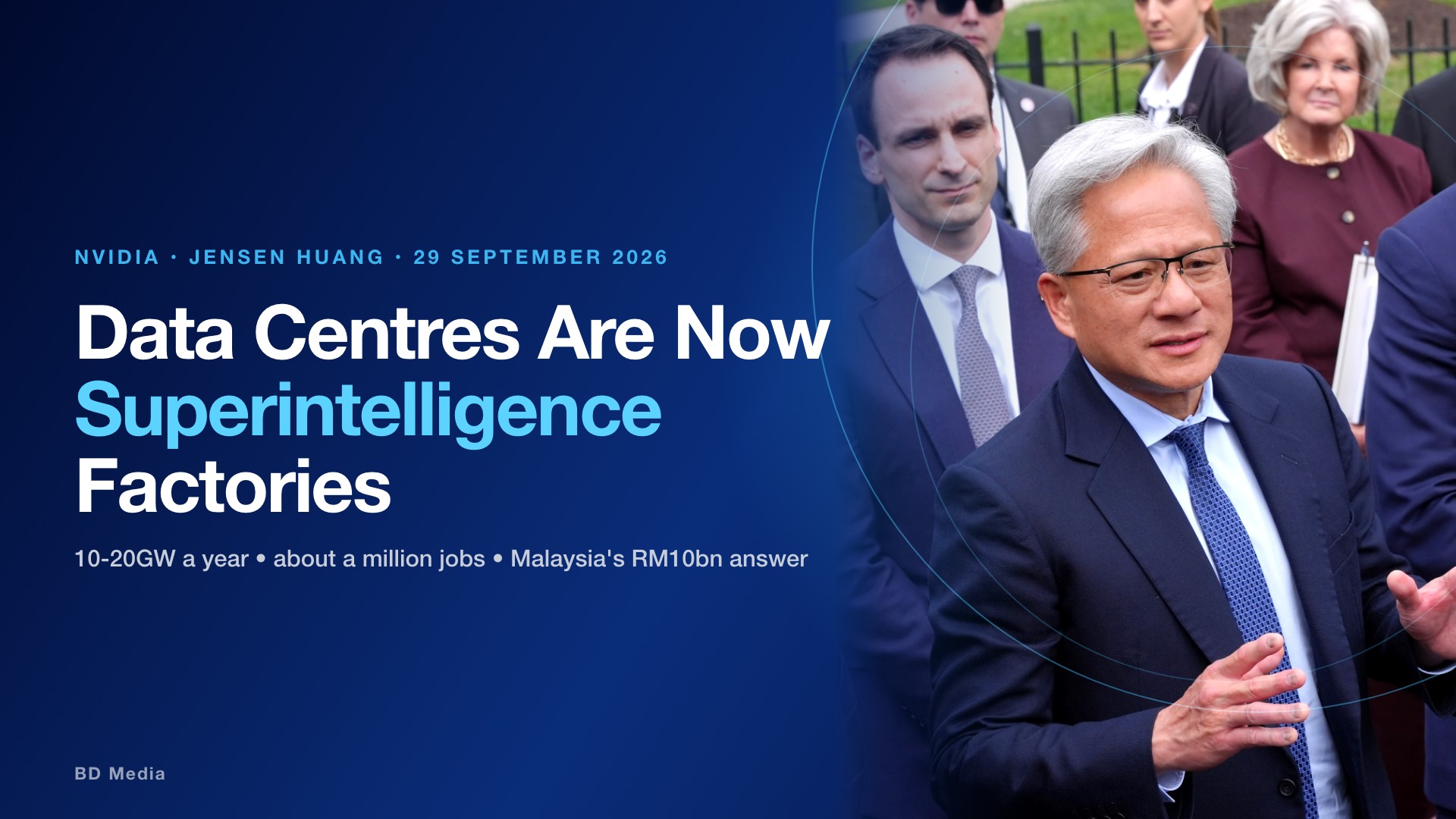
Superintelligence factory is what Nvidia’s chief executive Jensen Huang called the data centre on 29 September 2026, speaking to reporters at the White House after President Trump signed an order renaming artificial intelligence across the US federal government. The phrase reads like branding. The numbers Huang attached to it are an industrial forecast, and a specific one: the United States is adding somewhere between 10 and 20 gigawatts of AI infrastructure a year, and building it employs roughly a million people.
Malaysia is already building the same object. The first Nvidia-powered data centre in the country was completed in Kulai, Johor, under an RM10 billion partnership between YTL Power and Nvidia, announced on 31 October 2025 (Free Malaysia Today). Budget 2026 put RM5.9 billion behind the sector, a figure from Investment, Trade and Industry Minister Tengku Zafrul Aziz. The reason this story is worth a Malaysian business’s time is not that Putrajaya is following a Washington line. It is that Malaysia ran into the constraint Huang is describing before he described it.
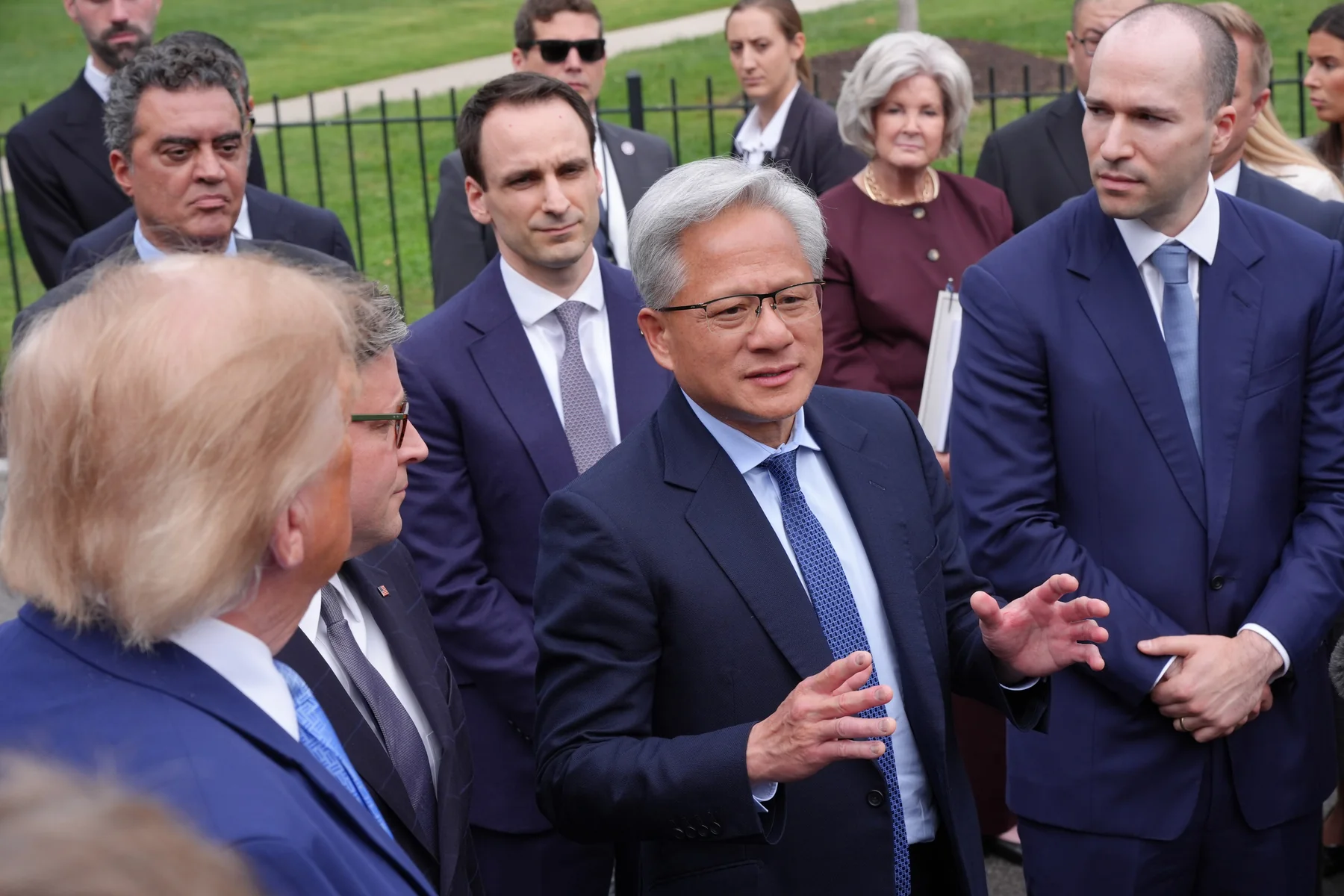
Jensen Huang speaks to reporters at the White House on 29 September 2026, after the executive order renaming AI. Photo: AP Photo/Jacquelyn Martin, via Hindustan Times.
Superintelligence factory: the claim, and where it was made
Huang spoke twice on 29 September. The first was the White House luncheon where President Trump gathered the chief executives of Nvidia, Google, Meta, Anthropic, OpenAI and xAI to sign the voluntary White House Accord on Super Intelligence — we covered what that accord does and does not bind anyone to in a separate piece. The second, less reported here, was an event marking the launch of the America.gov website, where Huang sat on a panel beside Elon Musk and made the economic argument rather than the political one.
It is that second set of remarks that carries the number.
“And so we’re building this infrastructure out and, call it across all of the United States, somewhere between 10, 20 gigawatts a year. Let’s just estimate, that creates just, probably about a million jobs in building out these data centers.” — Jensen Huang, co-founder and chief executive, Nvidia, at the America.gov launch event, Washington, 29 September 2026
“And so this is the first time in probably, as you mentioned, 35 I was going to say 50 years first time in 50 years we are reindustrializing the United States, creating a whole bunch of blue-collar jobs.” — Jensen Huang, co-founder and chief executive, Nvidia, 29 September 2026
Both quotes verbatim from Yahoo Finance’s report of the panel, 30 September 2026. Read them together and the rebrand makes sense on Huang’s own terms. A data centre, in his framing, is not a warehouse for other people’s files. It is a plant that produces something with a market price, it employs tradespeople to build and run it, and it is measured the way any factory is measured: in throughput and headcount. He also pointed past the buildings themselves to what has to be built first — power generation, cooling, the pipework — though we are paraphrasing that part rather than quoting it, because the wire versions of those lines differ in wording.
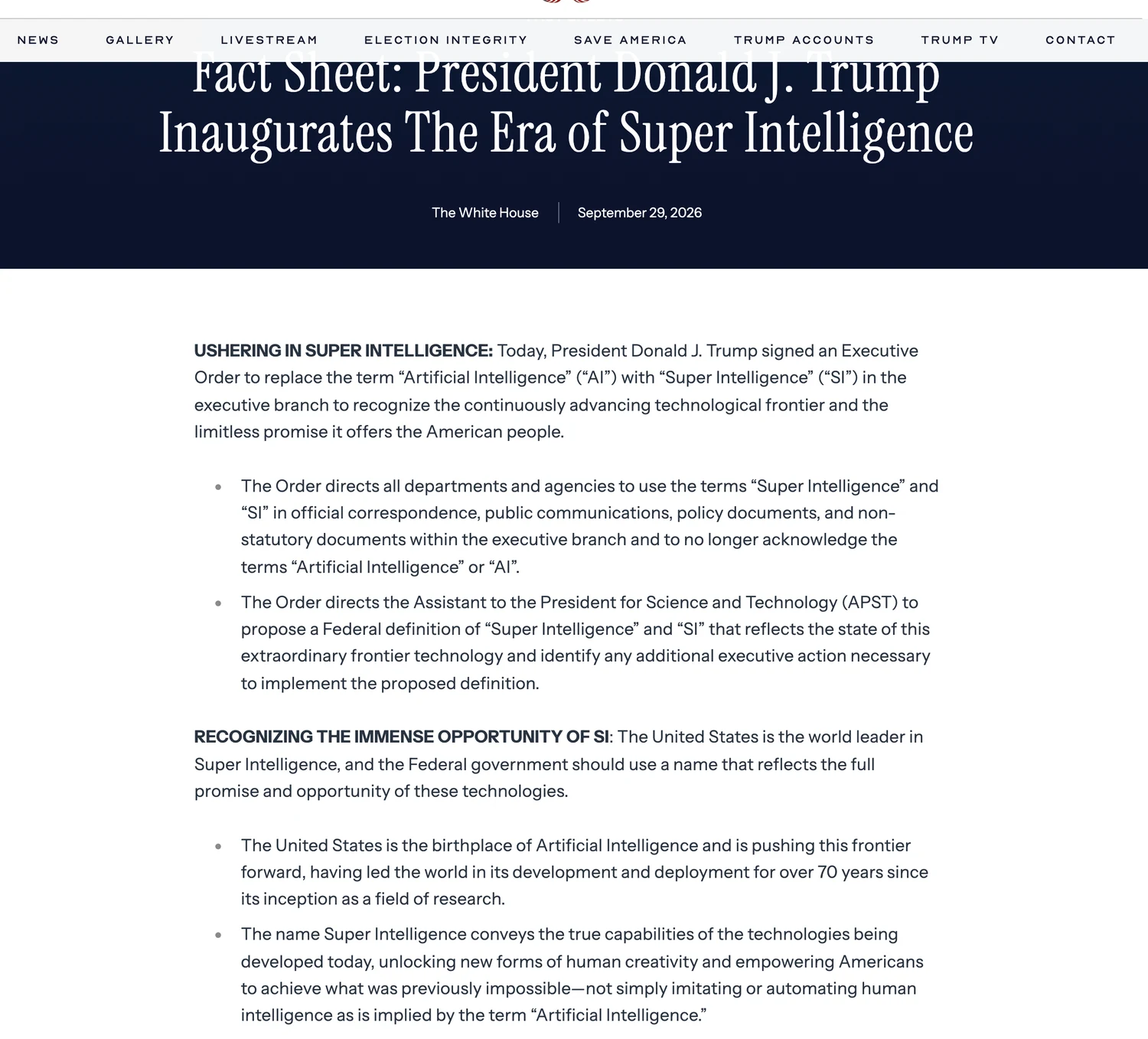
The White House’s own fact sheet of 29 September 2026, which directs agencies to use “Super Intelligence” and “SI” and to stop using “Artificial Intelligence” or “AI”. Source: The White House, whitehouse.gov.
What a superintelligence factory actually is
The terminology is contested and we are not going to relitigate it here. What matters commercially is the difference between the buildings most companies already understand and the ones being financed now.
| Traditional data centre | AI factory, as Huang describes it | |
|---|---|---|
| Primary output | Storage, hosting, availability | Tokens — inference sold by volume |
| Measured in | Racks, uptime, square metres | Gigawatts, and tokens per gigawatt |
| Dominant cost | Property, cooling, hardware refresh | Power, silicon, and the debt service on both |
| Construction profile | Fit-out of an existing shell | New-build industrial campus with its own generation |
| Jobs claim | Low per megawatt once running | Concentrated in the build: electricians, pipe fitters, plant |
The row that should interest a Malaysian policymaker more than any other is the second one. Huang is not selling a faster server. He is selling a unit of production, and pricing the build in gigawatts. That reframing is why the argument has moved on from chips.
The constraint Huang named: power, and pipe fitters
Two numbers from the same reporting sit behind the factory framing, and neither is about semiconductors. We would put both in front of any board looking at this market.
The first is labour. The Alliance for America’s Skilled Trades — an initiative launched by BlackRock, Carhartt, Ford and Google, which Nvidia, Meta and Microsoft joined that week — estimates the United States will need to fill 1.7 million skilled-trades openings annually through 2035, and that current training pipelines produce roughly 55 workers for every 100 needed (Yahoo Finance, 30 September 2026). In our reading, a factory with no trades is a shed with a power bill.
The second is electricity, and it is the one Malaysia already knows about from the inside.
Malaysia is already building these factories
This is not a country waiting to enter the story, and we want to be precise about that, because the numbers are large and they are dated.
The anchor is the YTL Green Data Centre Park in Kulai, Johor: a 1,640-acre site with a 600 megawatt grid supply, solar on site, running Nvidia’s GB200 NVL72 liquid-cooled systems (Astro Awani, 31 October 2025). The first Nvidia-powered data centre in Malaysia was completed there, a milestone announced on 31 October 2025 when Prime Minister Anwar Ibrahim met Huang and YTL Power managing director Yeoh Seok Hong on the sidelines of the APEC summit in Gyeongju (Free Malaysia Today, 31 October 2025). The partnership is reported at RM10 billion, a figure carried by Free Malaysia Today, New Straits Times and Astro Awani.
Yeoh said 300 megawatts were already built and commissioned on the site, with full occupancy expected within two years (Astro Awani, 31 October 2025). The same infrastructure runs ILMU, the large language model launched in August 2025 and described by YTL as Malaysian-owned intellectual property.
Public money is following the private capital. Investment, Trade and Industry Minister Tengku Zafrul Aziz said the government had allocated RM5.9 billion to the AI sector in Budget 2026, with the stated aim of positioning Malaysia as a regional hub for data centres and AI innovation (Free Malaysia Today, 31 October 2025).
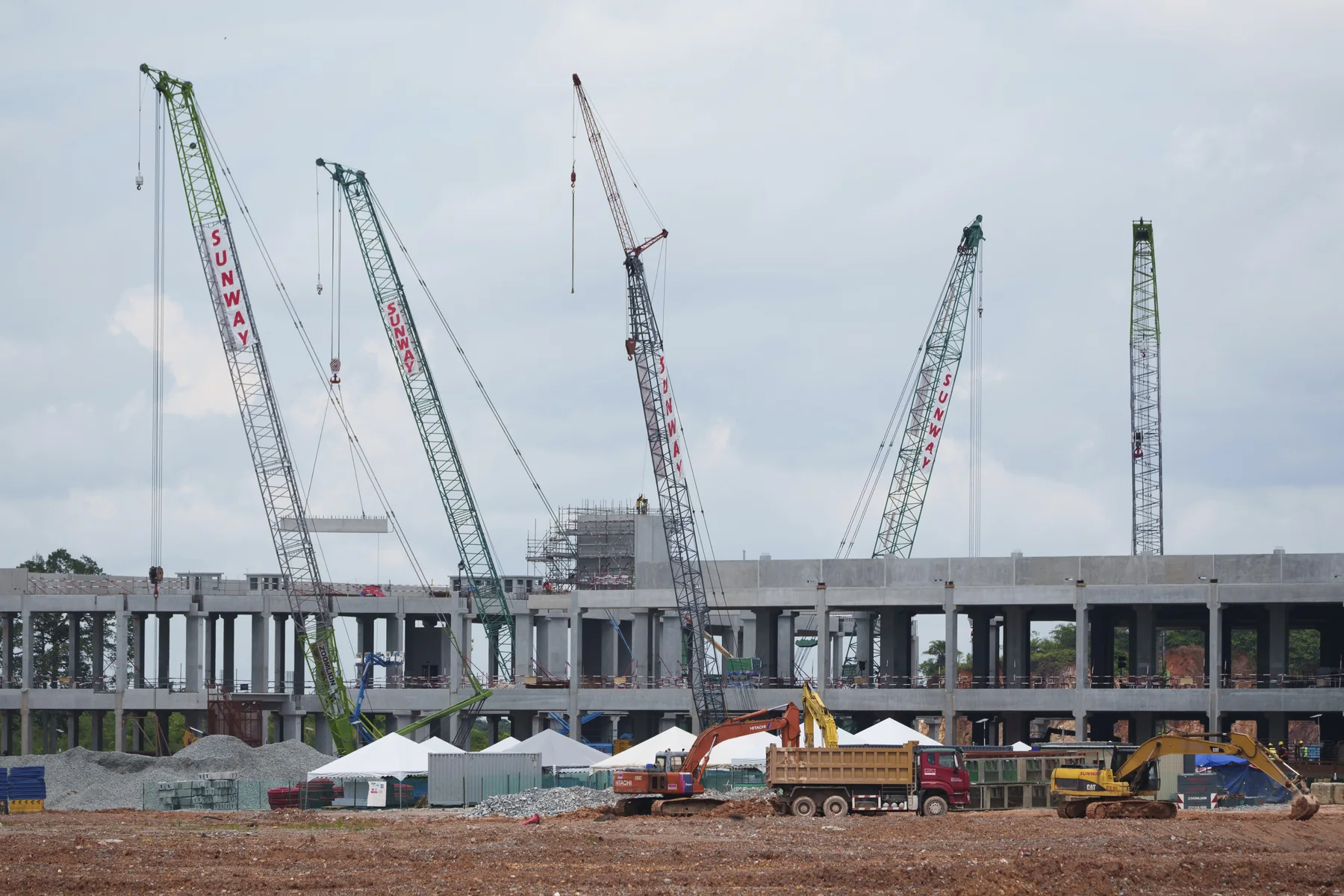
A data centre building under construction at Sedenak Tech Park, Johor, on 27 September 2024. Photo: AP Photo/Vincent Thian.
The wider build-out is bigger than one campus. Johor held at least 1.6 gigawatts of data centre capacity by early 2025, up from close to nothing in 2019, making it the fastest-growing data centre market in Southeast Asia, and researchers at Kenanga Investment Bank projected demand from future Malaysian facilities could exceed 5 gigawatts by 2035 (Associated Press, February 2025). For scale, the International Energy Agency figures cited in the same report put fossil fuels at over 95 per cent of Malaysia’s available energy in 2022.
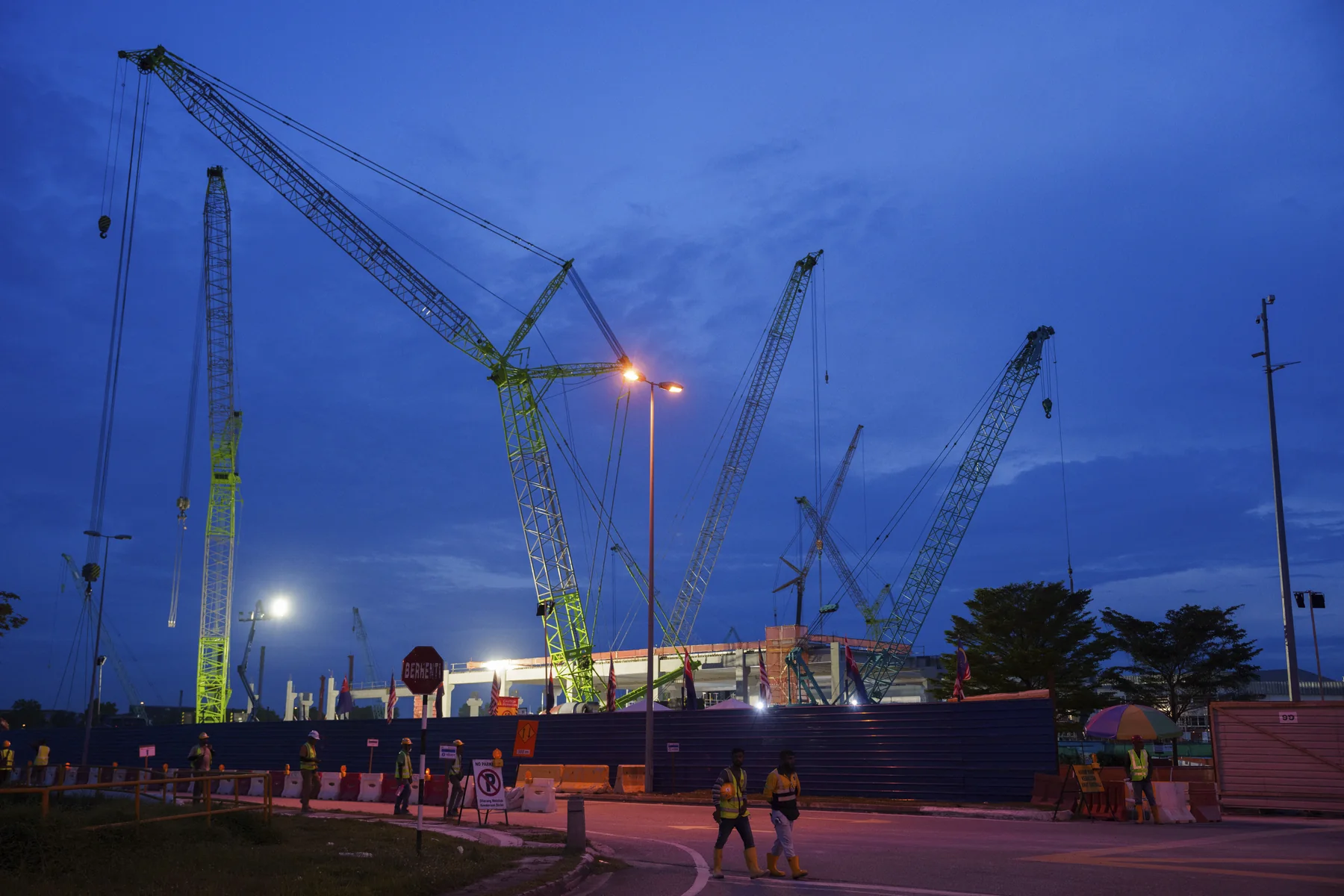
Construction workers outside a data centre under construction in Johor Bahru, 28 September 2024 — the workforce Huang’s jobs forecast describes. Photo: AP Photo/Vincent Thian.
Malaysia hit the constraint first
Here is the part that makes Huang’s framing useful rather than decorative. The two pressures he named — power and labour — arrived in Malaysia’s data centre economy before the superintelligence vocabulary did.
Electricity tariffs for data centres were reset in July 2025, adding a reported 10 to 14 per cent to energy costs and placing facilities above 100 megawatts in the highest voltage band (AIinASIA, July 2026). By early 2026 the federal government had stopped approving new data centres unrelated to AI workloads, citing electricity and water pressure — a position the Prime Minister confirmed in February 2026 (AIinASIA; equalOne). Johor had already been screening applications through a state vetting committee and rejecting a share of them on utility grounds.
That is a government acting on exactly the constraint Huang was describing to an American audience: the factory is not limited by how many chips you can buy. It is limited by whether the grid, the water and the trades exist at the site.
The gap on the demand side is the other half of the picture, and it is the one we would put in front of any Malaysian SME reading this. An AWS study of 1,000 Malaysian firms found 27 per cent had formally adopted AI, up from 20 per cent a year earlier, with 73 per cent of adopters using only basic tools and 52 per cent naming a skills shortage as their biggest barrier (equalOne, citing the AWS study). Malaysia is building world-class supply and running modest demand. Those two facts do not reconcile by themselves.
What we would actually take from the week. The phrase “superintelligence factory” will age badly or well depending on what happens to the technology, and no business decision should rest on it. The gigawatt forecast might. If you sell into the build — construction services, power, cooling, connectivity, compliance, or the applications that sit on top of the compute — the constraint to plan around is electricity and skilled labour, in that order. If you buy the output, the unit that matters is the token, and the price of a token is what the factory is being built to drive down.
Teams working out what their own AI consumption actually costs, across several models and vendors, can see how the BigDomain LLM Token Hub consolidates keys, routing and spend in one place.
Sources
- Yahoo Finance / GuruFocus, “Nvidia CEO Makes Massive Prediction About American Jobs”, 30 September 2026 — source of the Jensen Huang quotes above
- Hindustan Times, “Nvidia’s Jensen Huang calls data centers ‘superintelligence factories'”, 30 September 2026 (reporting AP)
- The White House, “Fact Sheet: President Donald J. Trump Inaugurates The Era of Super Intelligence”, 29 September 2026
- Free Malaysia Today, “Malaysia completes first Nvidia-powered data centre in Johor”, 31 October 2025
- Astro Awani, “YTL Power champions Malaysia’s AI transformation with Johor mega data centre”, 31 October 2025
- New Straits Times, “Johor proud to host Nvidia’s rare AI facility”, September 2025
- Associated Press (Aniruddha Ghosal and Vincent Thian), “Malaysia is betting on data centers to boost its economy”, February 2025
- AIinASIA, “Malaysia: AIinASIA Policy Atlas”, July 2026
- equalOne, “Malaysia’s AI Gamble: Who Will Be Prioritised?”, 2026 — carries the AWS adoption study figures
- BD Media, “Super Intelligence vs AI: What Trump’s Order Changes”, 30 September 2026